 As I sit at my desk and think about what to write for the April Newsletter this Tuesday of Holy Week I remembered an email I received from Old Lutheran. Their idea or concept for this Easter is Jesus Woke. And so they sent this in an email to explain that.
“Woke means to be aware of and actively attentive to important facts and issues. It is in that context that we know that Jesus is WOKE to injustice and WOKE to indifference. Not only on Easter Sunday when Mary and the others went to the tomb and discovered that he was WOKE but Jesus is WOKE to the sins of humanity. In Jesus Resurrection we are all WOKE in Christ.”
I think of Easter being April 1, April Fools day and wonder, would Jesus joke with the disciples on this most important morning. Jesus came out of the tomb and saw His shadow and said, “Sorry guys, 6 more weeks of Lent!” This is a Jesus who is woke.
Jesus was aware and attentive to the issues in the lives of the disciples and all of those around Him, then when He walked this earth and now, as He walks it with us. Jesus is aware of what is happening in all of those who trust Him lives and seeking to help them and guide them through the ups and downs of life.
I wonder if we are woke to anything other than ourselves? When things don’t go like we want them, or we don’t get our way how do we respond? Are we attentive and aware of the issues in the lives of the people we are close to? Do you know what is happening in your neighbor’s life? Or are we so wrapped up in our own issues we can’t see them?
Jesus just died when He could have stopped it, but He knew it was not about Him, even though it is all about Him. Jesus woke and was woke all of His earthly and God’s kingdom existence.
So are you Woke? Because in His Resurrection we are all Woke in Christ!
Grace,
PJ

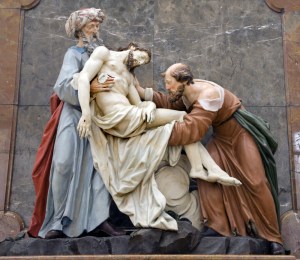 After these things, Joseph of Arimathea, who was a disciple of Jesus, though a secret one because of his fear of the Jews, asked Pilate to let him take away the body of Jesus. Pilate gave him permission; so he came and removed his body. Nicodemus, who had at first come to Jesus by night, also came, bringing a mixture of myrrh and aloes, weighing about a hundred pounds. They took the body of Jesus and wrapped it with the spices in linen cloths, according to the burial custom of the Jews. Now there was a garden in the place where he was crucified, and in the garden there was a new tomb in which no one had ever been laid. And so, because it was the Jewish day of Preparation, and the tomb was nearby, they laid Jesus there. (John 19:38-42, NRSV)
 Since it was the day of Preparation, the Jews did not want the bodies left on the cross during the sabbath, especially because that sabbath was a day of great solemnity. So they asked Pilate to have the legs of the crucified men broken and the bodies removed. Then the soldiers came and broke the legs of the first and of the other who had been crucified with him. But when they came to Jesus and saw that he was already dead, they did not break his legs. Instead, one of the soldiers pierced his side with a spear, and at once blood and water came out. (He who saw this has testified so that you also may believe. His testimony is true, and he knows that he tells the truth.) These things occurred so that the scripture might be fulfilled, “None of his bones shall be broken.” And again another passage of scripture says, “They will look on the one whom they have pierced.” (John 19:31-37, NRSV)
 When the soldiers had crucified Jesus, they took his clothes and divided them into four parts, one for each soldier. They also took his tunic; now the tunic was seamless, woven in one piece from the top. So they said to one another, “Let us not tear it, but cast lots for it to see who will get it.” This was to fulfill what the scripture says, “They divided my clothes among themselves, and for my clothing they cast lots.” And that is what the soldiers did. Meanwhile, standing near the cross of Jesus were his mother, and his mother’s sister, Mary the wife of Clopas, and Mary Magdalene. When Jesus saw his mother and the disciple whom he loved standing beside her, he said to his mother, “Woman, here is your son.” Then he said to the disciple, “Here is your mother.” And from that hour the disciple took her into his own home. After this, when Jesus knew that all was now finished, he said (in order to fulfill the scripture), “I am thirsty.” A jar full of sour wine was standing there. So they put a sponge full of the wine on a branch of hyssop and held it to his mouth. When Jesus had received the wine, he said, “It is finished.” Then he bowed his head and gave up his spirit. (John 19:23-30, NRSV)
 After Jesus had spoken these words, he went out with his disciples across the Kidron valley to a place where there was a garden, which he and his disciples entered. Now Judas, who betrayed him, also knew the place, because Jesus often met there with his disciples. So Judas brought a detachment of soldiers together with police from the chief priests and the Pharisees, and they came there with lanterns and torches and weapons. Then Jesus, knowing all that was to happen to him, came forward and asked them, “Whom are you looking for?” They answered, “Jesus of Nazareth.” Jesus replied, “I am he.” Judas, who betrayed him, was standing with them. When Jesus said to them, “I am he,” they stepped back and fell to the ground. Again he asked them, “Whom are you looking for?” And they said, “Jesus of Nazareth.” Jesus answered, “I told you that I am he. So if you are looking for me, let these men go.” This was to fulfill the word that he had spoken, “I did not lose a single one of those whom you gave me.” Then Simon Peter, who had a sword, drew it, struck the high priest’s slave, and cut off his right ear. The slave’s name was Malchus. Jesus said to Peter, “Put your sword back into its sheath. Am I not to drink the cup that the Father has given me?” (John 18:1-11, NRSV)
 aSacredRebel