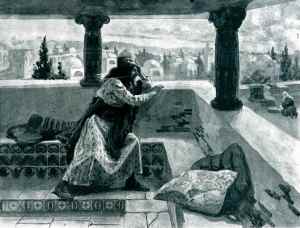
 In the spring of the year, the time when kings go out to battle, David sent Joab with his officers and all Israel with him; they ravaged the Ammonites, and besieged Rabbah. But David remained at Jerusalem. It happened, late one afternoon, when David rose from his couch and was walking about on the roof of the king’s house, that he saw from the roof a woman bathing; the woman was very beautiful. David sent someone to inquire about the woman. It was reported, “This is Bathsheba daughter of Eliam, the wife of Uriah the Hittite.” So David sent messengers to get her, and she came to him, and he lay with her. (Now she was purifying herself after her period.) Then she returned to her house. The woman conceived; and she sent and told David, “I am pregnant.” So David sent word to Joab, “Send me Uriah the Hittite.” And Joab sent Uriah to David. When Uriah came to him, David asked how Joab and the people fared, and how the war was going. Then David said to Uriah, “Go down to your house, and wash your feet.” Uriah went out of the king’s house, and there followed him a present from the king. But Uriah slept at the entrance of the king’s house with all the servants of his lord, and did not go down to his house. When they told David, “Uriah did not go down to his house,” David said to Uriah, “You have just come from a journey. Why did you not go down to your house?” Uriah said to David, “The ark and Israel and Judah remain in booths; and my lord Joab and the servants of my lord are camping in the open field; shall I then go to my house, to eat and to drink, and to lie with my wife? As you live, and as your soul lives, I will not do such a thing.” Then David said to Uriah, “Remain here today also, and tomorrow I will send you back.” So Uriah remained in Jerusalem that day. On the next day, David invited him to eat and drink in his presence and made him drunk; and in the evening he went out to lie on his couch with the servants of his lord, but he did not go down to his house. (2 Samuel 11:1-13, NRSV)
Have you ever seen something that wasn’t yours that you wanted?
What did you do?
Here we see David saw a beautiful woman and he wanted to be with her. So as king he could have her come to him and so he did. She came and the laid together and she got pregnant. So David tries to cover it up by bringing her husband home from war and telling him to go home. David supposes the man will go home and lay with his wife and then he will think the child is his. But Uriah stays by the king’s house for he is dedicated to the army and his king.
So David’s plan is foiled and he must do something different.
Why do we not covet? Because that leads to other problems and cover-ups and that is never good.
If we stay with what is ours and know that God has provided what we need, we will always be better off.
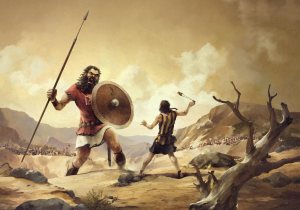 When the words that David spoke were heard, they repeated them before Saul; and he sent for him. David said to Saul, “Let no one’s heart fail because of him; your servant will go and fight with this Philistine.” Saul said to David, “You are not able to go against this Philistine to fight with him; for you are just a boy, and he has been a warrior from his youth.”But David said to Saul, “Your servant used to keep sheep for his father; and whenever a lion or a bear came, and took a lamb from the flock, I went after it and struck it down, rescuing the lamb from its mouth; and if it turned against me, I would catch it by the jaw, strike it down, and kill it. Your servant has killed both lions and bears; and this uncircumcised Philistine shall be like one of them, since he has defied the armies of the living God.” David said, “The
  Now David was the son of an Ephrathite of Bethlehem in Judah, named Jesse, who had eight sons. In the days of Saul the man was already old and advanced in years. The three eldest sons of Jesse had followed Saul to the battle; the names of his three sons who went to the battle were Eliab the firstborn, and next to him Abinadab, and the third Shammah. David was the youngest; the three eldest followed Saul, but David went back and forth from Saul to feed his father’s sheep at Bethlehem. For forty days the Philistine came forward and took his stand, morning and evening. Jesse said to his son David, “Take for your brothers an ephah of this parched grain and these ten loaves, and carry them quickly to the camp to your brothers; also take these ten cheeses to the commander of their thousand. See how your brothers fare, and bring some token from them.” Now Saul, and they, and all the men of Israel, were in the valley of Elah, fighting with the Philistines. David rose early in the morning, left the sheep with a keeper, took the provisions, and went as Jesse had commanded him. He came to the encampment as the army was going forth to the battle line, shouting the war cry. Israel and the Philistines drew up for battle, army against army. David left the things in charge of the keeper of the baggage, ran to the ranks, and went and greeted his brothers. As he talked with them, the champion, the Philistine of Gath, Goliath by name, came up out of the ranks of the Philistines, and spoke the same words as before. And David heard him. All the Israelites, when they saw the man, fled from him and were very much afraid. The Israelites said, “Have you seen this man who has come up? Surely he has come up to defy Israel. The king will greatly enrich the man who kills him, and will give him his daughter and make his family free in Israel.” David said to the men who stood by him, “What shall be done for the man who kills this Philistine, and takes away the reproach from Israel? For who is this uncircumcised Philistine that he should defy the armies of the living God?” The people answered him in the same way, “So shall it be done for the man who kills him.” His eldest brother Eliab heard him talking to the men; and Eliab’s anger was kindled against David. He said, “Why have you come down? With whom have you left those few sheep in the wilderness? I know your presumption and the evil of your heart; for you have come down just to see the battle.” David said, “What have I done now? It was only a question.” He turned away from him toward another and spoke in the same way; and the people answered him again as before. (1 Samuel 17:12-30, NRSV)
 The
The  Then Joshua gathered all the tribes of Israel to Shechem, and summoned the elders, the heads, the judges, and the officers of Israel; and they presented themselves before God. And Joshua said to all the people, “Thus says the
  When the entire nation had finished crossing over the Jordan, the
 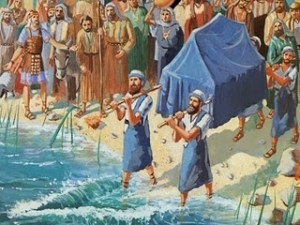 Early in the morning Joshua rose and set out from Shittim with all the Israelites, and they came to the Jordan. They camped there before crossing over. At the end of three days the officers went through the camp and commanded the people, “When you see the ark of the covenant of the
  After the death of Moses the servant of the
 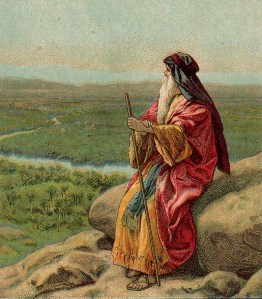 Then Moses went up from the plains of Moab to Mount Nebo, to the top of Pisgah, which is opposite Jericho, and the
