 Moses was keeping the flock of his father-in-law Jethro, the priest of Midian; he led his flock beyond the wilderness, and came to Horeb, the mountain of God. There the angel of the Lord appeared to him in a flame of fire out of a bush; he looked, and the bush was blazing, yet it was not consumed. Then Moses said, “I must turn aside and look at this great sight, and see why the bush is not burned up.” When the Lord saw that he had turned aside to see, God called to him out of the bush, “Moses, Moses!” And he said, “Here I am.” Then he said, “Come no closer! Remove the sandals from your feet, for the place on which you are standing is holy ground.” He said further, “I am the God of your father, the God of Abraham, the God of Isaac, and the God of Jacob.” And Moses hid his face, for he was afraid to look at God. Then the Lord said, “I have observed the misery of my people who are in Egypt; I have heard their cry on account of their taskmasters. Indeed, I know their sufferings, and I have come down to deliver them from the Egyptians, and to bring them up out of that land to a good and broad land, a land flowing with milk and honey, to the country of the Canaanites, the Hittites, the Amorites, the Perizzites, the Hivites, and the Jebusites. The cry of the Israelites has now come to me; I have also seen how the Egyptians oppress them. So come, I will send you to Pharaoh to bring my people, the Israelites, out of Egypt.” But Moses said to God, “Who am I that I should go to Pharaoh, and bring the Israelites out of Egypt?” He said, “I will be with you; and this shall be the sign for you that it is I who sent you: when you have brought the people out of Egypt, you shall worship God on this mountain.” But Moses said to God, “If I come to the Israelites and say to them, ‘The God of your ancestors has sent me to you,’ and they ask me, ‘What is his name?’ what shall I say to them?” God said to Moses, “I AM WHO I AM.” He said further, “Thus you shall say to the Israelites, ‘I AM has sent me to you.’“God also said to Moses, “Thus you shall say to the Israelites, ‘The Lord, the God of your ancestors, the God of Abraham, the God of Isaac, and the God of Jacob, has sent me to you’: This is my name forever, and this my title for all generations. Go and assemble the elders of Israel, and say to them, ‘The Lord, the God of your ancestors, the God of Abraham, of Isaac, and of Jacob, has appeared to me, saying: I have given heed to you and to what has been done to you in Egypt. I declare that I will bring you up out of the misery of Egypt, to the land of the Canaanites, the Hittites, the Amorites, the Perizzites, the Hivites, and the Jebusites, a land flowing with milk and honey.’ (Exodus 3:1-17, NRSV)
What would you do if you saw a bush on fire and it was not actually burning?
And then if that isn’t enough, a voice comes out of the bush, and it is God and God is telling you to go back to a place you fled from because of something terrible you did there.
And God is telling you to go and do something you really don’t want to do and you think you are not capable of doing.
What would you do?
I believe God does speak to us today just like this. And we are so busy or so annoyed or so insert action word here that we miss it. We miss God trying to tell us something.
All of us have our burning bush. What is yours?
And the real question is will you go?
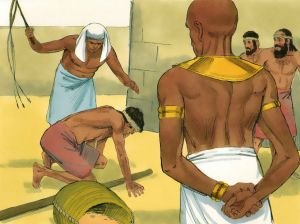 Now a new king arose over Egypt, who did not know Joseph. He said to his people, “Look, the Israelite people are more numerous and more powerful than we. Come, let us deal shrewdly with them, or they will increase and, in the event of war, join our enemies and fight against us and escape from the land.” Therefore they set taskmasters over them to oppress them with forced labor. They built supply cities, Pithom and Rameses, for Pharaoh. But the more they were oppressed, the more they multiplied and spread, so that the Egyptians came to dread the Israelites. The Egyptians became ruthless in imposing tasks on the Israelites, and made their lives bitter with hard service in mortar and brick and in every kind of field labor. They were ruthless in all the tasks that they imposed on them. (Exodus 1:8-14, NRSV)
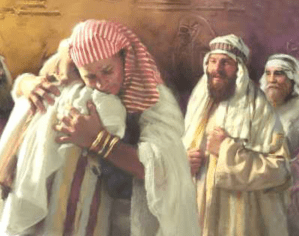 So Joseph went and told Pharaoh, “My father and my brothers, with their flocks and herds and all that they possess, have come from the land of Canaan; they are now in the land of Goshen.” From among his brothers he took five men and presented them to Pharaoh. Pharaoh said to his brothers, “What is your occupation?” And they said to Pharaoh, “Your servants are shepherds, as our ancestors were.” They said to Pharaoh, “We have come to reside as aliens in the land; for there is no pasture for your servants’ flocks because the famine is severe in the land of Canaan. Now, we ask you, let your servants settle in the land of Goshen.” Then Pharaoh said to Joseph, “Your father and your brothers have come to you. The land of Egypt is before you; settle your father and your brothers in the best part of the land; let them live in the land of Goshen; and if you know that there are capable men among them, put them in charge of my livestock.” Then Joseph brought in his father Jacob, and presented him before Pharaoh, and Jacob blessed Pharaoh. Pharaoh said to Jacob, “How many are the years of your life?” Jacob said to Pharaoh, “The years of my earthly sojourn are one hundred thirty; few and hard have been the years of my life. They do not compare with the years of the life of my ancestors during their long sojourn.” Then Jacob blessed Pharaoh, and went out from the presence of Pharaoh. Joseph settled his father and his brothers, and granted them a holding in the land of Egypt, in the best part of the land, in the land of Rameses, as Pharaoh had instructed. And Joseph provided his father, his brothers, and all his father’s household with food, according to the number of their dependents. (Genesis 47:1-12, NRSV)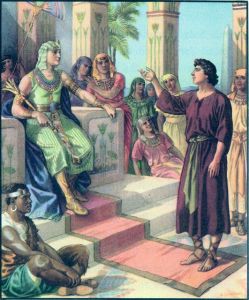
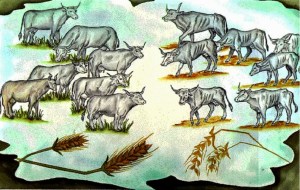 After two whole years, Pharaoh dreamed that he was standing by the Nile, and there came up out of the Nile seven sleek and fat cows, and they grazed in the reed grass. Then seven other cows, ugly and thin, came up out of the Nile after them, and stood by the other cows on the bank of the Nile. The ugly and thin cows ate up the seven sleek and fat cows. And Pharaoh awoke. Then he fell asleep and dreamed a second time; seven ears of grain, plump and good, were growing on one stalk. Then seven ears, thin and blighted by the east wind, sprouted after them. The thin ears swallowed up the seven plump and full ears. Pharaoh awoke, and it was a dream. In the morning his spirit was troubled; so he sent and called for all the magicians of Egypt and all its wise men. Pharaoh told them his dreams, but there was no one who could interpret them to Pharaoh. Then the chief cupbearer said to Pharaoh, “I remember my faults today. Once Pharaoh was angry with his servants, and put me and the chief baker in custody in the house of the captain of the guard. We dreamed on the same night, he and I, each having a dream with its own meaning. A young Hebrew was there with us, a servant of the captain of the guard. When we told him, he interpreted our dreams to us, giving an interpretation to each according to his dream. As he interpreted to us, so it turned out; I was restored to my office, and the baker was hanged.” (Genesis 41:1-13, NRSV)
 Now Joseph was taken down to Egypt, and Potiphar, an officer of Pharaoh, the captain of the guard, an Egyptian, bought him from the Ishmaelites who had brought him down there. The
 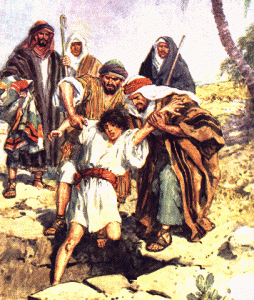 Then they sat down to eat, and looking up they saw a caravan of Ishmaelites coming from Gilead, with their camels carrying gum, balm, and resin, on their way to carry it down to Egypt. Then Judah said to his brothers, “What profit is it if we kill our brother and conceal his blood? Come, let us sell him to the Ishmaelites, and not lay our hands on him, for he is our brother, our own flesh.” And his brothers agreed. When some Midianite traders passed by, they drew Joseph up, lifting him out of the pit, and sold him to the Ishmaelites for twenty pieces of silver. And they took Joseph to Egypt. When Reuben returned to the pit and saw that Joseph was not in the pit, he tore his clothes. He returned to his brothers, and said, “The boy is gone; and I, where can I turn?” Then they took Joseph’s robe, slaughtered a goat, and dipped the robe in the blood. They had the long robe with sleeves taken to their father, and they said, “This we have found; see now whether it is your son’s robe or not.” He recognized it, and said, “It is my son’s robe! A wild animal has devoured him; Joseph is without doubt torn to pieces.” Then Jacob tore his garments, and put sackcloth on his loins, and mourned for his son many days. All his sons and all his daughters sought to comfort him; but he refused to be comforted, and said, “No, I shall go down to Sheol to my son, mourning.” Thus his father bewailed him. Meanwhile the Midianites had sold him in Egypt to Potiphar, one of Pharaoh’s officials, the captain of the guard. (Genesis 37:25-36, NRSV)
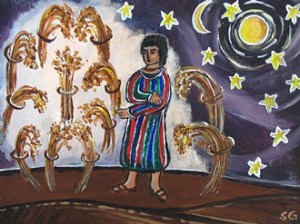 Jacob settled in the land where his father had lived as an alien, the land of Canaan. This is the story of the family of Jacob. Joseph, being seventeen years old, was shepherding the flock with his brothers; he was a helper to the sons of Bilhah and Zilpah, his father’s wives; and Joseph brought a bad report of them to their father. Now Israel loved Joseph more than any other of his children, because he was the son of his old age; and he had made him a long robe with sleeves. But when his brothers saw that their father loved him more than all his brothers, they hated him, and could not speak peaceably to him. Once Joseph had a dream, and when he told it to his brothers, they hated him even more. He said to them, “Listen to this dream that I dreamed. There we were, binding sheaves in the field. Suddenly my sheaf rose and stood upright; then your sheaves gathered around it, and bowed down to my sheaf.” His brothers said to him, “Are you indeed to reign over us? Are you indeed to have dominion over us?” So they hated him even more because of his dreams and his words. He had another dream, and told it to his brothers, saying, “Look, I have had another dream: the sun, the moon, and eleven stars were bowing down to me.” But when he told it to his father and to his brothers, his father rebuked him, and said to him, “What kind of dream is this that you have had? Shall we indeed come, I and your mother and your brothers, and bow to the ground before you?”So his brothers were jealous of him, but his father kept the matter in mind. Now his brothers went to pasture their father’s flock near Shechem. And Israel said to Joseph, “Are not your brothers pasturing the flock at Shechem? Come, I will send you to them.” He answered, “Here I am.” So he said to him, “Go now, see if it is well with your brothers and with the flock; and bring word back to me.” So he sent him from the valley of Hebron. He came to Shechem, and a man found him wandering in the fields; the man asked him, “What are you seeking?” “I am seeking my brothers,” he said; “tell me, please, where they are pasturing the flock.”The man said, “They have gone away, for I heard them say, ‘Let us go to Dothan.’“ So Joseph went after his brothers, and found them at Dothan. They saw him from a distance, and before he came near to them, they conspired to kill him. They said to one another, “Here comes this dreamer. Come now, let us kill him and throw him into one of the pits; then we shall say that a wild animal has devoured him, and we shall see what will become of his dreams.” But when Reuben heard it, he delivered him out of their hands, saying, “Let us not take his life.” Reuben said to them, “Shed no blood; throw him into this pit here in the wilderness, but lay no hand on him” —that he might rescue him out of their hand and restore him to his father. So when Joseph came to his brothers, they stripped him of his robe, the long robe with sleeves that he wore; and they took him and threw him into a pit. The pit was empty; there was no water in it. (Genesis 37:1-24, NRSV)
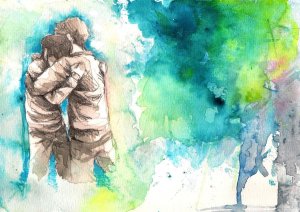 Now Jacob looked up and saw Esau coming, and four hundred men with him. So he divided the children among Leah and Rachel and the two maids. He put the maids with their children in front, then Leah with her children, and Rachel and Joseph last of all. He himself went on ahead of them, bowing himself to the ground seven times, until he came near his brother. But Esau ran to meet him, and embraced him, and fell on his neck and kissed him, and they wept. When Esau looked up and saw the women and children, he said, “Who are these with you?” Jacob said, “The children whom God has graciously given your servant.” Then the maids drew near, they and their children, and bowed down; Leah likewise and her children drew near and bowed down; and finally Joseph and Rachel drew near, and they bowed down. Esau said, “What do you mean by all this company that I met?” Jacob answered, “To find favor with my lord.” But Esau said, “I have enough, my brother; keep what you have for yourself.” Jacob said, “No, please; if I find favor with you, then accept my present from my hand; for truly to see your face is like seeing the face of God—since you have received me with such favor. Please accept my gift that is brought to you, because God has dealt graciously with me, and because I have everything I want.” So he urged him, and he took it. Then Esau said, “Let us journey on our way, and I will go alongside you.” But Jacob said to him, “My lord knows that the children are frail and that the flocks and herds, which are nursing, are a care to me; and if they are overdriven for one day, all the flocks will die. Let my lord pass on ahead of his servant, and I will lead on slowly, according to the pace of the cattle that are before me and according to the pace of the children, until I come to my lord in Seir.” So Esau said, “Let me leave with you some of the people who are with me.” But he said, “Why should my lord be so kind to me?” (Genesis 33:1-15, NRSV)
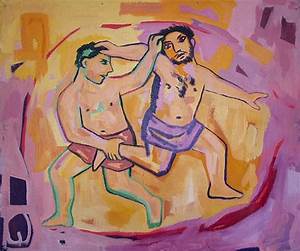 These are the descendants of Isaac, Abraham’s son: Abraham was the father of Isaac, and Isaac was forty years old when he married Rebekah, daughter of Bethuel the Aramean of Paddan-aram, sister of Laban the Aramean. Isaac prayed to the
  aSacredRebel