 The Lord saw that the wickedness of humankind was great in the earth, and that every inclination of the thoughts of their hearts was only evil continually. And the Lord was sorry that he had made humankind on the earth, and it grieved him to his heart. So the Lord said, ‘I will blot out from the earth the human beings I have created—people together with animals and creeping things and birds of the air, for I am sorry that I have made them.’ But Noah found favour in the sight of the Lord. These are the descendants of Noah. Noah was a righteous man, blameless in his generation; Noah walked with God. And Noah had three sons, Shem, Ham, and Japheth. Now the earth was corrupt in God’s sight, and the earth was filled with violence. And God saw that the earth was corrupt; for all flesh had corrupted its ways upon the earth. And God said to Noah, ‘I have determined to make an end of all flesh, for the earth is filled with violence because of them; now I am going to destroy them along with the earth. Make yourself an ark of cypress wood; make rooms in the ark, and cover it inside and out with pitch. This is how you are to make it: the length of the ark three hundred cubits, its width fifty cubits, and its height thirty cubits. Make a roof for the ark, and finish it to a cubit above; and put the door of the ark in its side; make it with lower, second, and third decks. For my part, I am going to bring a flood of waters on the earth, to destroy from under heaven all flesh in which is the breath of life; everything that is on the earth shall die. But I will establish my covenant with you; and you shall come into the ark, you, your sons, your wife, and your sons’ wives with you. And of every living thing, of all flesh, you shall bring two of every kind into the ark, to keep them alive with you; they shall be male and female. Of the birds according to their kinds, and of the animals according to their kinds, of every creeping thing of the ground according to its kind, two of every kind shall come in to you, to keep them alive. Also take with you every kind of food that is eaten, and store it up; and it shall serve as food for you and for them.’ Noah did this; he did all that God commanded him. At the end of forty days Noah opened the window of the ark that he had made and sent out the raven; and it went to and fro until the waters were dried up from the earth. Then he sent out the dove from him, to see if the waters had subsided from the face of the ground; but the dove found no place to set its foot, and it returned to him to the ark, for the waters were still on the face of the whole earth. So he put out his hand and took it and brought it into the ark with him. He waited another seven days, and again he sent out the dove from the ark; and the dove came back to him in the evening, and there in its beak was a freshly plucked olive leaf; so Noah knew that the waters had subsided from the earth. Then he waited another seven days, and sent out the dove; and it did not return to him any more. Then God said to Noah and to his sons with him, ‘As for me, I am establishing my covenant with you and your descendants after you, and with every living creature that is with you, the birds, the domestic animals, and every animal of the earth with you, as many as came out of the ark. I establish my covenant with you, that never again shall all flesh be cut off by the waters of a flood, and never again shall there be a flood to destroy the earth.’ God said, ‘This is the sign of the covenant that I make between me and you and every living creature that is with you, for all future generations: I have set my bow in the clouds, and it shall be a sign of the covenant between me and the earth. When I bring clouds over the earth and the bow is seen in the clouds, I will remember my covenant that is between me and you and every living creature of all flesh; and the waters shall never again become a flood to destroy all flesh. When the bow is in the clouds, I will see it and remember the everlasting covenant between God and every living creature of all flesh that is on the earth.’God said to Noah, ‘This is the sign of the covenant that I have established between me and all flesh that is on the earth.’ (Genesis 6:5-22; 8:6-12; 9:8-17, NRSV)
Have you ever been in a quandary and didn’t know how it would work out?
2 years ago on this day, my life was turned upside down. Something happened that I wasn’t sure how I would get through it or how it would change my life.
I prayed that God would take care of what was happening and intervein so His will is done.
So many things happened that day and in the following 2 years and my life is still whirling. But through it all, God has never left me.
God has never failed on His promise to be with me.
This is only one time in the Bible that God shares a promise and a notion that God will always be with us and for us. So just as Noah did, believe that God will follow through and build the boat, even when there is no water, even when you don’t understand, because He will be with you and He will keep His promises…
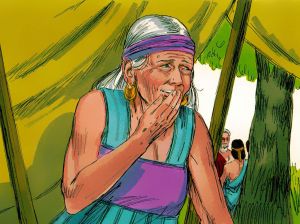
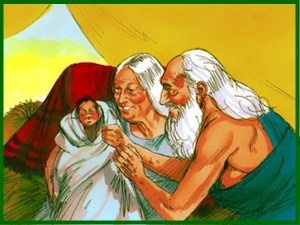 The Lord dealt with Sarah as he had said, and the Lord did for Sarah as he had promised. Sarah conceived and bore Abraham a son in his old age, at the time of which God had spoken to him. Abraham gave the name Isaac to his son whom Sarah bore him. And Abraham circumcised his son Isaac when he was eight days old, as God had commanded him. Abraham was a hundred years old when his son Isaac was born to him. Now Sarah said, “God has brought laughter for me; everyone who hears will laugh with me.” And she said, “Who would ever have said to Abraham that Sarah would nurse children? Yet I have borne him a son in his old age.” The child grew, and was weaned; and Abraham made a great feast on the day that Isaac was weaned. (Genesis 21:1-8, NRSV)
 The
The  Now the
  Now these are the descendants of Terah. Terah was the father of Abram, Nahor, and Haran; and Haran was the father of Lot. Haran died before his father Terah in the land of his birth, in Ur of the Chaldeans. Abram and Nahor took wives; the name of Abram’s wife was Sarai, and the name of Nahor’s wife was Milcah. She was the daughter of Haran the father of Milcah and Iscah. Now Sarai was barren; she had no child. Terah took his son Abram and his grandson Lot son of Haran, and his daughter-in-law Sarai, his son Abram’s wife, and they went out together from Ur of the Chaldeans to go into the land of Canaan; but when they came to Haran, they settled there. The days of Terah were two hundred and five years; and Terah died in Haran. (Genesis 11:27-32, NRSV)
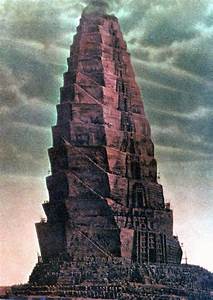 Now the whole earth had one language and the same words. And as they migrated from the east, they came upon a plain in the land of Shinar and settled there. And they said to one another, ‘Come, let us make bricks, and burn them thoroughly.’ And they had brick for stone, and bitumen for mortar. Then they said, ‘Come, let us build ourselves a city, and a tower with its top in the heavens, and let us make a name for ourselves; otherwise we shall be scattered abroad upon the face of the whole earth.’The
 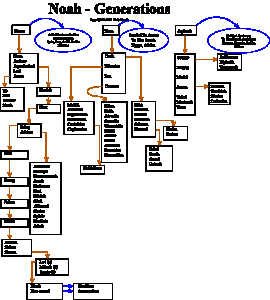 Canaan became the father of Sidon his firstborn, and Heth, and the Jebusites, the Amorites, the Girgashites, the Hivites, the Arkites, the Sinites, the Arvadites, the Zemarites, and the Hamathites. Afterwards the families of the Canaanites spread abroad. And the territory of the Canaanites extended from Sidon, in the direction of Gerar, as far as Gaza, and in the direction of Sodom, Gomorrah, Admah, and Zeboiim, as far as Lasha. These are the descendants of Ham, by their families, their languages, their lands, and their nations. To Shem also, the father of all the children of Eber, the elder brother of Japheth, children were born. The descendants of Shem: Elam, Asshur, Arpachshad, Lud, and Aram. The descendants of Aram: Uz, Hul, Gether, and Mash. Arpachshad became the father of Shelah; and Shelah became the father of Eber. To Eber were born two sons: the name of one was Peleg, for in his days the earth was divided, and his brother’s name was Joktan. Joktan became the father of Almodad, Sheleph, Hazarmaveth, Jerah, Hadoram, Uzal, Diklah, Obal, Abimael, Sheba, Ophir, Havilah, and Jobab; all these were the descendants of Joktan. The territory in which they lived extended from Mesha in the direction of Sephar, the hill country of the east. These are the descendants of Shem, by their families, their languages, their lands, and their nations. These are the families of Noah’s sons, according to their genealogies, in their nations; and from these the nations spread abroad on the earth after the flood. (Genesis 10:15-32, NRSV)
 These are the descendants of Noah’s sons, Shem, Ham, and Japheth; children were born to them after the flood. The descendants of Japheth: Gomer, Magog, Madai, Javan, Tubal, Meshech, and Tiras. The descendants of Gomer: Ashkenaz, Riphath, and Togarmah. The descendants of Javan: Elishah, Tarshish, Kittim, and Rodanim. From these the coastland peoples spread. These are the descendants of Japheth in their lands, with their own language, by their families, in their nations. The descendants of Ham: Cush, Egypt, Put, and Canaan. The descendants of Cush: Seba, Havilah, Sabtah, Raamah, and Sabteca. The descendants of Raamah: Sheba and Dedan. Cush became the father of Nimrod; he was the first on earth to become a mighty warrior. He was a mighty hunter before the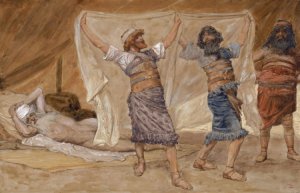
 aSacredRebel