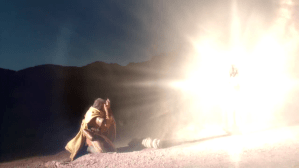
 Meanwhile Saul, still breathing threats and murder against the disciples of the Lord, went to the high priest and asked him for letters to the synagogues at Damascus, so that if he found any who belonged to the Way, men or women, he might bring them bound to Jerusalem. Now as he was going along and approaching Damascus, suddenly a light from heaven flashed around him. He fell to the ground and heard a voice saying to him, “Saul, Saul, why do you persecute me?” He asked, “Who are you, Lord?” The reply came, “I am Jesus, whom you are persecuting. But get up and enter the city, and you will be told what you are to do.”The men who were traveling with him stood speechless because they heard the voice but saw no one. Saul got up from the ground, and though his eyes were open, he could see nothing; so they led him by the hand and brought him into Damascus. For three days he was without sight, and neither ate nor drank. Now there was a disciple in Damascus named Ananias. The Lord said to him in a vision, “Ananias.” He answered, “Here I am, Lord.” The Lord said to him, “Get up and go to the street called Straight, and at the house of Judas look for a man of Tarsus named Saul. At this moment he is praying, and he has seen in a vision a man named Ananias come in and lay his hands on him so that he might regain his sight.” But Ananias answered, “Lord, I have heard from many about this man, how much evil he has done to your saints in Jerusalem; and here he has authority from the chief priests to bind all who invoke your name.” But the Lord said to him, “Go, for he is an instrument whom I have chosen to bring my name before Gentiles and kings and before the people of Israel; I myself will show him how much he must suffer for the sake of my name.” So Ananias went and entered the house. He laid his hands on Saul and said, “Brother Saul, the Lord Jesus, who appeared to you on your way here, has sent me so that you may regain your sight and be filled with the Holy Spirit.” And immediately something like scales fell from his eyes, and his sight was restored. Then he got up and was baptized, and after taking some food, he regained his strength. For several days he was with the disciples in Damascus, and immediately he began to proclaim Jesus in the synagogues, saying, “He is the Son of God.” All who heard him were amazed and said, “Is not this the man who made havoc in Jerusalem among those who invoked this name? And has he not come here for the purpose of bringing them bound before the chief priests?” Saul became increasingly more powerful and confounded the Jews who lived in Damascus by proving that Jesus was the Messiah. (Acts 9:1-22, NRSV)
This is a wonderful text that shows the power of a call from God. Saul wanted letters from the high priest to go to Damascus so he could arrest people of The Way if he found any. The Way is what they called those that followed Jesus. Not Christians, but followers of the way.
And Jesus met Saul on the road, and told him to go into the city. Now, why would Saul do this? He doesn’t believe in or follow Jesus. Why would he listen to a bright light? But he did.
The God tells Ananias to go to where Saul is and to lay hands on him and pray for him. Ananias is concerned because he has heard about the man and doesn’t want anything to do with him. Saul arrests followers of Jesus, puts them in jail, or worse has them put to death. This isn’t someone a follower of Jesus wants to mess with. You would want to keep a good distance between you and Saul as a follower of Christ. But God needs Ananias to go to Saul.
Has God ever called you to do something you didn’t want to do?
Asked you to go somewhere you didn’t want to go?
Ananias was really only trying to preserve his life. But sometimes God asks us to put everything on the line for His will.
And when Ananias was faithful to God, Saul was transformed from a persecutor of the way to a profound proclaimer of the way!
Saul saw the light! Literally and started confounding the Jews by his proclamation of Jesus.
Have you seen the light? Are you being called to do something you don’t want to?
Are you hesitant to follow where God is leading?
Just think of all of the great things that could happen if you are faithful.
 The next day he got up and went with them, and some of the believers from Joppa accompanied him. The following day they came to Caesarea. Cornelius was expecting them and had called together his relatives and close friends. On Peter’s arrival Cornelius met him, and falling at his feet, worshiped him. But Peter made him get up, saying, “Stand up; I am only a mortal.” And as he talked with him, he went in and found that many had assembled; and he said to them, “You yourselves know that it is unlawful for a Jew to associate with or to visit a Gentile; but God has shown me that I should not call anyone profane or unclean. So when I was sent for, I came without objection. Now may I ask why you sent for me?” Cornelius replied, “Four days ago at this very hour, at three o’clock, I was praying in my house when suddenly a man in dazzling clothes stood before me. He said, ‘Cornelius, your prayer has been heard and your alms have been remembered before God. Send therefore to Joppa and ask for Simon, who is called Peter; he is staying in the home of Simon, a tanner, by the sea.’Therefore I sent for you immediately, and you have been kind enough to come. So now all of us are here in the presence of God to listen to all that the Lord has commanded you to say.” (Acts 10:23b-33, NRSV)
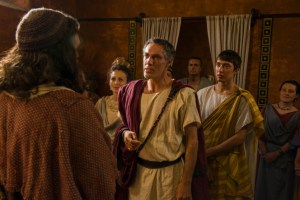 Now while Peter was greatly puzzled about what to make of the vision that he had seen, suddenly the men sent by Cornelius appeared. They were asking for Simon’s house and were standing by the gate. They called out to ask whether Simon, who was called Peter, was staying there. While Peter was still thinking about the vision, the Spirit said to him, “Look, three men are searching for you. Now get up, go down, and go with them without hesitation; for I have sent them.” So Peter went down to the men and said, “I am the one you are looking for; what is the reason for your coming?” They answered, “Cornelius, a centurion, an upright and God-fearing man, who is well spoken of by the whole Jewish nation, was directed by a holy angel to send for you to come to his house and to hear what you have to say.” So Peter invited them in and gave them lodging. (Acts 10:17-23a, NRSV)
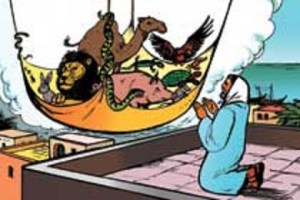 In Caesarea there was a man named Cornelius, a centurion of the Italian Cohort, as it was called. He was a devout man who feared God with all his household; he gave alms generously to the people and prayed constantly to God. One afternoon at about three o’clock he had a vision in which he clearly saw an angel of God coming in and saying to him, “Cornelius.” He stared at him in terror and said, “What is it, Lord?” He answered, “Your prayers and your alms have ascended as a memorial before God. Now send men to Joppa for a certain Simon who is called Peter; he is lodging with Simon, a tanner, whose house is by the seaside.” When the angel who spoke to him had left, he called two of his slaves and a devout soldier from the ranks of those who served him, and after telling them everything, he sent them to Joppa. About noon the next day, as they were on their journey and approaching the city, Peter went up on the roof to pray. He became hungry and wanted something to eat; and while it was being prepared, he fell into a trance. He saw the heaven opened and something like a large sheet coming down, being lowered to the ground by its four corners. In it were all kinds of four-footed creatures and reptiles and birds of the air. Then he heard a voice saying, “Get up, Peter; kill and eat.” But Peter said, “By no means, Lord; for I have never eaten anything that is profane or unclean.”The voice said to him again, a second time, “What God has made clean, you must not call profane.” This happened three times, and the thing was suddenly taken up to heaven. (Acts 10:1-16, NRSV)
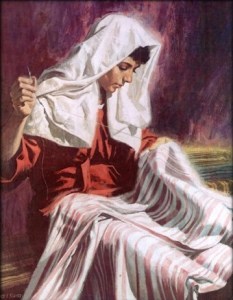 Now in Joppa there was a disciple whose name was Tabitha, which in Greek is Dorcas. She was devoted to good works and acts of charity. At that time she became ill and died. When they had washed her, they laid her in a room upstairs. Since Lydda was near Joppa, the disciples, who heard that Peter was there, sent two men to him with the request, “Please come to us without delay.” So Peter got up and went with them; and when he arrived, they took him to the room upstairs. All the widows stood beside him, weeping and showing tunics and other clothing that Dorcas had made while she was with them. Peter put all of them outside, and then he knelt down and prayed. He turned to the body and said, “Tabitha, get up.” Then she opened her eyes, and seeing Peter, she sat up. He gave her his hand and helped her up. Then calling the saints and widows, he showed her to be alive. This became known throughout Joppa, and many believed in the Lord. Meanwhile he stayed in Joppa for some time with a certain Simon, a tanner. (Acts 9:36-43, NRSV)
 After some time had passed, the Jews plotted to kill him, but their plot became known to Saul. They were watching the gates day and night so that they might kill him; but his disciples took him by night and let him down through an opening in the wall, lowering him in a basket. When he had come to Jerusalem, he attempted to join the disciples; and they were all afraid of him, for they did not believe that he was a disciple. But Barnabas took him, brought him to the apostles, and described for them how on the road he had seen the Lord, who had spoken to him, and how in Damascus he had spoken boldly in the name of Jesus. So he went in and out among them in Jerusalem, speaking boldly in the name of the Lord. He spoke and argued with the Hellenists; but they were attempting to kill him. When the believers learned of it, they brought him down to Caesarea and sent him off to Tarsus. Meanwhile the church throughout Judea, Galilee, and Samaria had peace and was built up. Living in the fear of the Lord and in the comfort of the Holy Spirit, it increased in numbers. (Acts 9:23-31, NRSV)
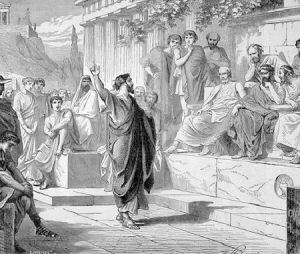 For several days he was with the disciples in Damascus, and immediately he began to proclaim Jesus in the synagogues, saying, “He is the Son of God.” All who heard him were amazed and said, “Is not this the man who made havoc in Jerusalem among those who invoked this name? And has he not come here for the purpose of bringing them bound before the chief priests?”Saul became increasingly more powerful and confounded the Jews who lived in Damascus by proving that Jesus was the Messiah. (Acts 9:19b-22, NRSV)
 When they heard these things, they became enraged and ground their teeth at Stephen. But filled with the Holy Spirit, he gazed into heaven and saw the glory of God and Jesus standing at the right hand of God. “Look,” he said, “I see the heavens opened and the Son of Man standing at the right hand of God!” But they covered their ears, and with a loud shout all rushed together against him. Then they dragged him out of the city and began to stone him; and the witnesses laid their coats at the feet of a young man named Saul. While they were stoning Stephen, he prayed, “Lord Jesus, receive my spirit.” Then he knelt down and cried out in a loud voice, “Lord, do not hold this sin against them.” When he had said this, he died. And Saul approved of their killing him. That day a severe persecution began against the church in Jerusalem, and all except the apostles were scattered throughout the countryside of Judea and Samaria. (Acts 7:54–8:1, NRSV)
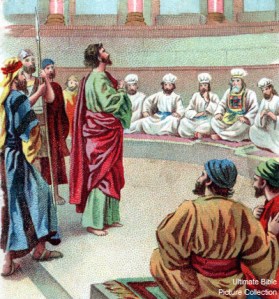 “Our ancestors had the tent of testimony in the wilderness, as God directed when he spoke to Moses, ordering him to make it according to the pattern he had seen. Our ancestors in turn brought it in with Joshua when they dispossessed the nations that God drove out before our ancestors. And it was there until the time of David, who found favor with God and asked that he might find a dwelling place for the house of Jacob.But it was Solomon who built a house for him. Yet the Most High does not dwell in houses made with human hands; as the prophet says, ‘Heaven is my throne, and the earth is my footstool. What kind of house will you build for me, says the Lord, or what is the place of my rest? Did not my hand make all these things?’ ”You stiff-necked people, uncircumcised in heart and ears, you are forever opposing the Holy Spirit, just as your ancestors used to do. Which of the prophets did your ancestors not persecute? They killed those who foretold the coming of the Righteous One, and now you have become his betrayers and murderers. You are the ones that received the law as ordained by angels, and yet you have not kept it.” (Acts 7:44-53, NRSV)
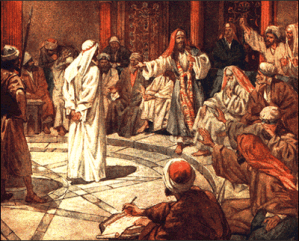 “When he was forty years old, it came into his heart to visit his relatives, the Israelites. When he saw one of them being wronged, he defended the oppressed man and avenged him by striking down the Egyptian. He supposed that his kinsfolk would understand that God through him was rescuing them, but they did not understand. The next day he came to some of them as they were quarreling and tried to reconcile them, saying, ‘Men, you are brothers; why do you wrong each other?’ But the man who was wronging his neighbor pushed Moses aside, saying, ‘Who made you a ruler and a judge over us? Do you want to kill me as you killed the Egyptian yesterday?’ When he heard this, Moses fled and became a resident alien in the land of Midian. There he became the father of two sons. “Now when forty years had passed, an angel appeared to him in the wilderness of Mount Sinai, in the flame of a burning bush. When Moses saw it, he was amazed at the sight; and as he approached to look, there came the voice of the Lord: ‘I am the God of your ancestors, the God of Abraham, Isaac, and Jacob.’ Moses began to tremble and did not dare to look. Then the Lord said to him, ‘Take off the sandals from your feet, for the place where you are standing is holy ground. I have surely seen the mistreatment of my people who are in Egypt and have heard their groaning, and I have come down to rescue them. Come now, I will send you to Egypt.’ “It was this Moses whom they rejected when they said, ‘Who made you a ruler and a judge?’ and whom God now sent as both ruler and liberator through the angel who appeared to him in the bush.He led them out, having performed wonders and signs in Egypt, at the Red Sea, and in the wilderness for forty years. This is the Moses who said to the Israelites, ‘God will raise up a prophet for you from your own people as he raised me up.’ He is the one who was in the congregation in the wilderness with the angel who spoke to him at Mount Sinai, and with our ancestors; and he received living oracles to give to us. Our ancestors were unwilling to obey him; instead, they pushed him aside, and in their hearts they turned back to Egypt, saying to Aaron, ‘Make gods for us who will lead the way for us; as for this Moses who led us out from the land of Egypt, we do not know what has happened to him.’ At that time they made a calf, offered a sacrifice to the idol, and revealed in the works of their hands. But God turned away from them and handed them over to worship the host of heaven, as it is written in the book of the prophets: ‘Did you offer to me slain victims and sacrifices forty years in the wilderness, O house of Israel? No; you took along the tent of Moloch, and the star of your god Rephan, the images that you made to worship; so I will remove you beyond Babylon.’ (Acts 7:23-43, NRSV)
 aSacredRebel