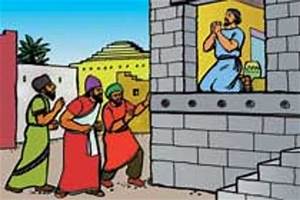
 It pleased Darius to set over the kingdom one hundred twenty satraps, stationed throughout the whole kingdom, and over them three presidents, including Daniel; to these the satraps gave account, so that the king might suffer no loss. Soon Daniel distinguished himself above all the other presidents and satraps because an excellent spirit was in him, and the king planned to appoint him over the whole kingdom. So the presidents and the satraps tried to find grounds for complaint against Daniel in connection with the kingdom. But they could find no grounds for complaint or any corruption, because he was faithful, and no negligence or corruption could be found in him. The men said, “We shall not find any ground for complaint against this Daniel unless we find it in connection with the law of his God.” So the presidents and satraps conspired and came to the king and said to him, “O King Darius, live forever! All the presidents of the kingdom, the prefects and the satraps, the counselors and the governors are agreed that the king should establish an ordinance and enforce an interdict, that whoever prays to anyone, divine or human, for thirty days, except to you, O king, shall be thrown into a den of lions. Now, O king, establish the interdict and sign the document, so that it cannot be changed, according to the law of the Medes and the Persians, which cannot be revoked.”Therefore King Darius signed the document and interdict. Although Daniel knew that the document had been signed, he continued to go to his house, which had windows in its upper room open toward Jerusalem, and to get down on his knees three times a day to pray to his God and praise him, just as he had done previously. The conspirators came and found Daniel praying and seeking mercy before his God. Then they approached the king and said concerning the interdict, “O king! Did you not sign an interdict, that anyone who prays to anyone, divine or human, within thirty days except to you, O king, shall be thrown into a den of lions?” The king answered, “The thing stands fast, according to the law of the Medes and Persians, which cannot be revoked.” Then they responded to the king, “Daniel, one of the exiles from Judah, pays no attention to you, O king, or to the interdict you have signed, but he is saying his prayers three times a day.” (Daniel 6:1-13, NRSV)
Do you pray to God?
Daniel was a foreigner who found himself in a place of power in the kingdom he was in. And those whom he had power over didn’t like this. So they tried to make a way to get him removed from the power. They could find no legitimate reason for getting him removed so they attacked his religion, which was different from theirs. They knew that Daniel was devout and would not sway from his faith in God.
Is there anyone out there that knows this about you. This reminds me of the saying, “If you were put on trial for being a follower of Jesus, would there be enough evidence to convict you?”
How can we help the world see the coming Savior and know that He is coming for them because He loves them?
 Then Daniel was brought in before the king. The king said to Daniel, “So you are Daniel, one of the exiles of Judah, whom my father the king brought from Judah? I have heard of you that a spirit of the gods is in you, and that enlightenment, understanding, and excellent wisdom are found in you. Now the wise men, the enchanters, have been brought in before me to read this writing and tell me its interpretation, but they were not able to give the interpretation of the matter. But I have heard that you can give interpretations and solve problems. Now if you are able to read the writing and tell me its interpretation, you shall be clothed in purple, have a chain of gold around your neck, and rank third in the kingdom.” Then Daniel answered in the presence of the king, “Let your gifts be for yourself, or give your rewards to someone else! Nevertheless I will read the writing to the king and let him know the interpretation. O king, the Most High God gave your father Nebuchadnezzar kingship, greatness, glory, and majesty. And because of the greatness that he gave him, all peoples, nations, and languages trembled and feared before him. He killed those he wanted to kill, kept alive those he wanted to keep alive, honored those he wanted to honor, and degraded those he wanted to degrade. But when his heart was lifted up and his spirit was hardened so that he acted proudly, he was deposed from his kingly throne, and his glory was stripped from him. He was driven from human society, and his mind was made like that of an animal. His dwelling was with the wild asses, he was fed grass like oxen, and his body was bathed with the dew of heaven, until he learned that the Most High God has sovereignty over the kingdom of mortals, and sets over it whomever he will. And you, Belshazzar his son, have not humbled your heart, even though you knew all this! You have exalted yourself against the Lord of heaven! The vessels of his temple have been brought in before you, and you and your lords, your wives and your concubines have been drinking wine from them. You have praised the gods of silver and gold, of bronze, iron, wood, and stone, which do not see or hear or know; but the God in whose power is your very breath, and to whom belong all your ways, you have not honored. “So from his presence the hand was sent and this writing was inscribed. And this is the writing that was inscribed: MENE, MENE, TEKEL, and PARSIN. This is the interpretation of the matter: MENE, God has numbered the days of your kingdom and brought it to an end; TEKEL, you have been weighed on the scales and found wanting; PERES, your kingdom is divided and given to the Medes and Persians.” Then Belshazzar gave the command, and Daniel was clothed in purple, a chain of gold was put around his neck, and a proclamation was made concerning him that he should rank third in the kingdom. That very night Belshazzar, the Chaldean king, was killed. And Darius the Mede received the kingdom, being about sixty-two years old. (Daniel 5:13-31, NRSV)
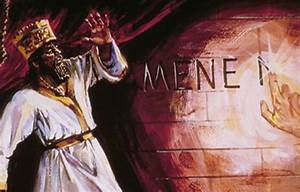 King Belshazzar made a great festival for a thousand of his lords, and he was drinking wine in the presence of the thousand. Under the influence of the wine, Belshazzar commanded that they bring in the vessels of gold and silver that his father Nebuchadnezzar had taken out of the temple in Jerusalem, so that the king and his lords, his wives, and his concubines might drink from them. So they brought in the vessels of gold and silver that had been taken out of the temple, the house of God in Jerusalem, and the king and his lords, his wives, and his concubines drank from them. They drank the wine and praised the gods of gold and silver, bronze, iron, wood, and stone. Immediately the fingers of a human hand appeared and began writing on the plaster of the wall of the royal palace, next to the lampstand. The king was watching the hand as it wrote. Then the king’s face turned pale, and his thoughts terrified him. His limbs gave way, and his knees knocked together. The king cried aloud to bring in the enchanters, the Chaldeans, and the diviners; and the king said to the wise men of Babylon, “Whoever can read this writing and tell me its interpretation shall be clothed in purple, have a chain of gold around his neck, and rank third in the kingdom.” Then all the king’s wise men came in, but they could not read the writing or tell the king the interpretation. Then King Belshazzar became greatly terrified and his face turned pale, and his lords were perplexed. The queen, when she heard the discussion of the king and his lords, came into the banqueting hall. The queen said, “O king, live forever! Do not let your thoughts terrify you or your face grow pale. There is a man in your kingdom who is endowed with a spirit of the holy gods. In the days of your father he was found to have enlightenment, understanding, and wisdom like the wisdom of the gods. Your father, King Nebuchadnezzar, made him chief of the magicians, enchanters, Chaldeans, and diviners, because an excellent spirit, knowledge, and understanding to interpret dreams, explain riddles, and solve problems were found in this Daniel, whom the king named Belteshazzar. Now let Daniel be called, and he will give the interpretation.” (Daniel 5:1-12, NRSV)
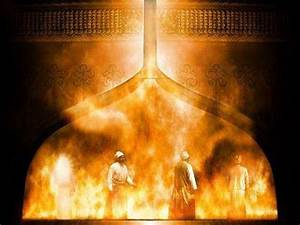 Then Nebuchadnezzar in furious rage commanded that Shadrach, Meshach, and Abednego be brought in; so they brought those men before the king. Nebuchadnezzar said to them, “Is it true, O Shadrach, Meshach, and Abednego, that you do not serve my gods and you do not worship the golden statue that I have set up? Now if you are ready when you hear the sound of the horn, pipe, lyre, trigon, harp, drum, and entire musical ensemble to fall down and worship the statue that I have made, well and good. But if you do not worship, you shall immediately be thrown into a furnace of blazing fire, and who is the god that will deliver you out of my hands?” Shadrach, Meshach, and Abednego answered the king, “O Nebuchadnezzar, we have no need to present a defense to you in this matter. If our God whom we serve is able to deliver us from the furnace of blazing fire and out of your hand, O king, let him deliver us. But if not, be it known to you, O king, that we will not serve your gods and we will not worship the golden statue that you have set up.” Then Nebuchadnezzar was so filled with rage against Shadrach, Meshach, and Abednego that his face was distorted. He ordered the furnace heated up seven times more than was customary, and ordered some of the strongest guards in his army to bind Shadrach, Meshach, and Abednego and to throw them into the furnace of blazing fire. So the men were bound, still wearing their tunics, their trousers, their hats, and their other garments, and they were thrown into the furnace of blazing fire. Because the king’s command was urgent and the furnace was so overheated, the raging flames killed the men who lifted Shadrach, Meshach, and Abednego. But the three men, Shadrach, Meshach, and Abednego, fell down, bound, into the furnace of blazing fire. Then King Nebuchadnezzar was astonished and rose up quickly. He said to his counselors, “Was it not three men that we threw bound into the fire?” They answered the king, “True, O king.” He replied, “But I see four men unbound, walking in the middle of the fire, and they are not hurt; and the fourth has the appearance of a god.” Nebuchadnezzar then approached the door of the furnace of blazing fire and said, “Shadrach, Meshach, and Abednego, servants of the Most High God, come out! Come here!” So Shadrach, Meshach, and Abednego came out from the fire. And the satraps, the prefects, the governors, and the king’s counselors gathered together and saw that the fire had not had any power over the bodies of those men; the hair of their heads was not singed, their tunics were not harmed, and not even the smell of fire came from them. Nebuchadnezzar said, “Blessed be the God of Shadrach, Meshach, and Abednego, who has sent his angel and delivered his servants who trusted in him. They disobeyed the king’s command and yielded up their bodies rather than serve and worship any god except their own God. Therefore I make a decree: Any people, nation, or language that utters blasphemy against the God of Shadrach, Meshach, and Abednego shall be torn limb from limb, and their houses laid in ruins; for there is no other god who is able to deliver in this way.” Then the king promoted Shadrach, Meshach, and Abednego in the province of Babylon. (Daniel 3:13-30, NRSV)
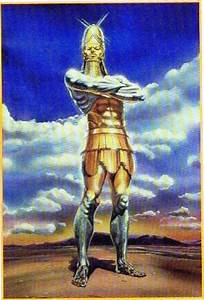 King Nebuchadnezzar made a golden statue whose height was sixty cubits and whose width was six cubits; he set it up on the plain of Dura in the province of Babylon. Then King Nebuchadnezzar sent for the satraps, the prefects, and the governors, the counselors, the treasurers, the justices, the magistrates, and all the officials of the provinces to assemble and come to the dedication of the statue that King Nebuchadnezzar had set up. So the satraps, the prefects, and the governors, the counselors, the treasurers, the justices, the magistrates, and all the officials of the provinces, assembled for the dedication of the statue that King Nebuchadnezzar had set up. When they were standing before the statue that Nebuchadnezzar had set up, the herald proclaimed aloud, “You are commanded, O peoples, nations, and languages, that when you hear the sound of the horn, pipe, lyre, trigon, harp, drum, and entire musical ensemble, you are to fall down and worship the golden statue that King Nebuchadnezzar has set up. Whoever does not fall down and worship shall immediately be thrown into a furnace of blazing fire.” Therefore, as soon as all the peoples heard the sound of the horn, pipe, lyre, trigon, harp, drum, and entire musical ensemble, all the peoples, nations, and languages fell down and worshiped the golden statue that King Nebuchadnezzar had set up. Accordingly, at this time certain Chaldeans came forward and denounced the Jews. They said to King Nebuchadnezzar, “O king, live forever! You, O king, have made a decree, that everyone who hears the sound of the horn, pipe, lyre, trigon, harp, drum, and entire musical ensemble, shall fall down and worship the golden statue, and whoever does not fall down and worship shall be thrown into a furnace of blazing fire. There are certain Jews whom you have appointed over the affairs of the province of Babylon: Shadrach, Meshach, and Abednego. These pay no heed to you, O King. They do not serve your gods and they do not worship the golden statue that you have set up.” (Daniel 3:1-12, NRSV)
 When Mordecai learned all that had been done, Mordecai tore his clothes and put on sackcloth and ashes, and went through the city, wailing with a loud and bitter cry; he went up to the entrance of the king’s gate, for no one might enter the king’s gate clothed with sackcloth. In every province, wherever the king’s command and his decree came, there was great mourning among the Jews, with fasting and weeping and lamenting, and most of them lay in sackcloth and ashes. When Esther’s maids and her eunuchs came and told her, the queen was deeply distressed; she sent garments to clothe Mordecai, so that he might take off his sackcloth; but he would not accept them. Then Esther called for Hathach, one of the king’s eunuchs, who had been appointed to attend her, and ordered him to go to Mordecai to learn what was happening and why. Hathach went out to Mordecai in the open square of the city in front of the king’s gate, and Mordecai told him all that had happened to him, and the exact sum of money that Haman had promised to pay into the king’s treasuries for the destruction of the Jews. Mordecai also gave him a copy of the written decree issued in Susa for their destruction, that he might show it to Esther, explain it to her, and charge her to go to the king to make supplication to him and entreat him for her people. Hathach went and told Esther what Mordecai had said. Then Esther spoke to Hathach and gave him a message for Mordecai, saying, “All the king’s servants and the people of the king’s provinces know that if any man or woman goes to the king inside the inner court without being called, there is but one law—all alike are to be put to death. Only if the king holds out the golden scepter to someone, may that person live. I myself have not been called to come in to the king for thirty days.” When they told Mordecai what Esther had said, Mordecai told them to reply to Esther, “Do not think that in the king’s palace you will escape any more than all the other Jews. For if you keep silence at such a time as this, relief and deliverance will rise for the Jews from another quarter, but you and your father’s family will perish. Who knows? Perhaps you have come to royal dignity for just such a time as this.” Then Esther said in reply to Mordecai, “Go, gather all the Jews to be found in Susa, and hold a fast on my behalf, and neither eat nor drink for three days, night or day. I and my maids will also fast as you do. After that I will go to the king, though it is against the law; and if I perish, I perish.” Mordecai then went away and did everything as Esther had ordered him. (Esther 4:1-17, NRSV)
 After these things King Ahasuerus promoted Haman son of Hammedatha the Agagite, and advanced him and set his seat above all the officials who were with him. And all the king’s servants who were at the king’s gate bowed down and did obeisance to Haman; for the king had so commanded concerning him. But Mordecai did not bow down or do obeisance. Then the king’s servants who were at the king’s gate said to Mordecai, “Why do you disobey the king’s command?” When they spoke to him day after day and he would not listen to them, they told Haman, in order to see whether Mordecai’s words would avail; for he had told them that he was a Jew. When Haman saw that Mordecai did not bow down or do obeisance to him, Haman was infuriated. But he thought it beneath him to lay hands on Mordecai alone. So, having been told who Mordecai’s people were, Haman plotted to destroy all the Jews, the people of Mordecai, throughout the whole kingdom of Ahasuerus. In the first month, which is the month of Nisan, in the twelfth year of King Ahasuerus, they cast Pur—which means “the lot” —before Haman for the day and for the month, and the lot fell on the thirteenth day of the twelfth month, which is the month of Adar. Then Haman said to King Ahasuerus, “There is a certain people scattered and separated among the peoples in all the provinces of your kingdom; their laws are different from those of every other people, and they do not keep the king’s laws, so that it is not appropriate for the king to tolerate them. If it pleases the king, let a decree be issued for their destruction, and I will pay ten thousand talents of silver into the hands of those who have charge of the king’s business, so that they may put it into the king’s treasuries.” So the king took his signet ring from his hand and gave it to Haman son of Hammedatha the Agagite, the enemy of the Jews. The king said to Haman, “The money is given to you, and the people as well, to do with them as it seems good to you.” Then the king’s secretaries were summoned on the thirteenth day of the first month, and an edict, according to all that Haman commanded, was written to the king’s satraps and to the governors over all the provinces and to the officials of all the peoples, to every province in its own script and every people in its own language; it was written in the name of King Ahasuerus and sealed with the king’s ring. Letters were sent by couriers to all the king’s provinces, giving orders to destroy, to kill, and to annihilate all Jews, young and old, women and children, in one day, the thirteenth day of the twelfth month, which is the month of Adar, and to plunder their goods. A copy of the document was to be issued as a decree in every province by proclamation, calling on all the peoples to be ready for that day. The couriers went quickly by order of the king, and the decree was issued in the citadel of Susa. The king and Haman sat down to drink; but the city of Susa was thrown into confusion. (Esther 3:1-15, NRSV)
 Dear Mr. “of Nazareth,”*
 The turn came for each girl to go in to King Ahasuerus, after being twelve months under the regulations for the women, since this was the regular period of their cosmetic treatment, six months with oil of myrrh and six months with perfumes and cosmetics for women. When the girl went in to the king she was given whatever she asked for to take with her from the harem to the king’s palace. In the evening she went in; then in the morning she came back to the second harem in custody of Shaashgaz, the king’s eunuch, who was in charge of the concubines; she did not go in to the king again, unless the king delighted in her and she was summoned by name. When the turn came for Esther daughter of Abihail the uncle of Mordecai, who had adopted her as his own daughter, to go in to the king, she asked for nothing except what Hegai the king’s eunuch, who had charge of the women, advised. Now Esther was admired by all who saw her. When Esther was taken to King Ahasuerus in his royal palace in the tenth month, which is the month of Tebeth, in the seventh year of his reign, the king loved Esther more than all the other women; of all the virgins she won his favor and devotion, so that he set the royal crown on her head and made her queen instead of Vashti. Then the king gave a great banquet to all his officials and ministers—“Esther’s banquet.” He also granted a holiday to the provinces, and gave gifts with royal liberality. When the virgins were being gathered together, Mordecai was sitting at the king’s gate. Now Esther had not revealed her kindred or her people, as Mordecai had charged her; for Esther obeyed Mordecai just as when she was brought up by him. In those days, while Mordecai was sitting at the king’s gate, Bigthan and Teresh, two of the king’s eunuchs, who guarded the threshold, became angry and conspired to assassinate King Ahasuerus. But the matter came to the knowledge of Mordecai, and he told it to Queen Esther, and Esther told the king in the name of Mordecai. When the affair was investigated and found to be so, both the men were hanged on the gallows. It was recorded in the book of the annals in the presence of the king. (Esther 2:12-23, NRSV)
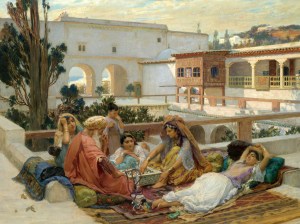 After these things, when the anger of King Ahasuerus had abated, he remembered Vashti and what she had done and what had been decreed against her. Then the king’s servants who attended him said, “Let beautiful young virgins be sought out for the king. And let the king appoint commissioners in all the provinces of his kingdom to gather all the beautiful young virgins to the harem in the citadel of Susa under custody of Hegai, the king’s eunuch, who is in charge of the women; let their cosmetic treatments be given them. And let the girl who pleases the king be queen instead of Vashti.” This pleased the king, and he did so. Now there was a Jew in the citadel of Susa whose name was Mordecai son of Jair son of Shimei son of Kish, a Benjaminite. Kish had been carried away from Jerusalem among the captives carried away with King Jeconiah of Judah, whom King Nebuchadnezzar of Babylon had carried away. Mordecai had brought up Hadassah, that is Esther, his cousin, for she had neither father nor mother; the girl was fair and beautiful, and when her father and her mother died, Mordecai adopted her as his own daughter. So when the king’s order and his edict were proclaimed, and when many young women were gathered in the citadel of Susa in custody of Hegai, Esther also was taken into the king’s palace and put in custody of Hegai, who had charge of the women. The girl pleased him and won his favor, and he quickly provided her with her cosmetic treatments and her portion of food, and with seven chosen maids from the king’s palace, and advanced her and her maids to the best place in the harem. Esther did not reveal her people or kindred, for Mordecai had charged her not to tell. Every day Mordecai would walk around in front of the court of the harem, to learn how Esther was and how she fared. (Esther 2:1-11, NRSV)
