
May the 4th be with you!
Thoughts from aSacredRebel following the SacredRebel
 In the morning the Jews joined in a conspiracy and bound themselves by an oath neither to eat nor drink until they had killed Paul. There were more than forty who joined in this conspiracy. They went to the chief priests and elders and said, “We have strictly bound ourselves by an oath to taste no food until we have killed Paul. Now then, you and the council must notify the tribune to bring him down to you, on the pretext that you want to make a more thorough examination of his case. And we are ready to do away with him before he arrives.” Now the son of Paul’s sister heard about the ambush; so he went and gained entrance to the barracks and told Paul. Paul called one of the centurions and said, “Take this young man to the tribune, for he has something to report to him.” So he took him, brought him to the tribune, and said, “The prisoner Paul called me and asked me to bring this young man to you; he has something to tell you.” The tribune took him by the hand, drew him aside privately, and asked, “What is it that you have to report to me?” He answered, “The Jews have agreed to ask you to bring Paul down to the council tomorrow, as though they were going to inquire more thoroughly into his case. But do not be persuaded by them, for more than forty of their men are lying in ambush for him. They have bound themselves by an oath neither to eat nor drink until they kill him. They are ready now and are waiting for your consent.” So the tribune dismissed the young man, ordering him, “Tell no one that you have informed me of this.” (Acts 23:12-22, NRSV)
How can these people say they follow a loving God if they vow to not eat or drink until they have killed someone?
What kind of religion causes people to want to kill others simply because they are different from them?
And Paul used to be one of them. It seems that would make them want to listen more because he was the one who was going around rounding up followers of the way so if he is now a part of the way I would want to know why not get rid of him.
So how do we react to those who are different?
Are we open and able to listen, or do we move quickly to get rid of all those who are different?
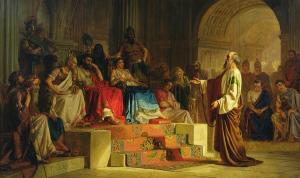 Just as Paul was about to be brought into the barracks, he said to the tribune, “May I say something to you?” The tribune replied, “Do you know Greek? Then you are not the Egyptian who recently stirred up a revolt and led the four thousand assassins out into the wilderness?” Paul replied, “I am a Jew, from Tarsus in Cilicia, a citizen of an important city; I beg you, let me speak to the people.” When he had given him permission, Paul stood on the steps and motioned to the people for silence; and when there was a great hush, he addressed them in the Hebrew language, saying: ”Brothers and fathers, listen to the defense that I now make before you.”When they heard him addressing them in Hebrew, they became even more quiet. Then he said: ”I am a Jew, born in Tarsus in Cilicia, but brought up in this city at the feet of Gamaliel, educated strictly according to our ancestral law, being zealous for God, just as all of you are today. I persecuted this Way up to the point of death by binding both men and women and putting them in prison, as the high priest and the whole council of elders can testify about me. From them I also received letters to the brothers in Damascus, and I went there in order to bind those who were there and to bring them back to Jerusalem for punishment. (Acts 21:37-22:5, NRSV)
So Paul knew the crowd he was speaking to.
When talking with the authorities of the city he spoke in Greek, and when he spoke to the crowd that had brought him from the temple he spoke in Hebrew.
You see in our understanding of being a disciple of Jesus context is very important. You use clues from the society you are speaking to to make sure they understand the message you are delivering. To speak to the authorities in Hebrew wouldn’t have worked. Well maybe one could have understood, and the same for the crowd from the temple. You have to deliver the message contextually so it is understood.
How do we deliver our message of good news? The way we always have? Or in the context of those to whom we are speaking?
 When the seven days were almost completed, the Jews from Asia, who had seen him in the temple, stirred up the whole crowd. They seized him, shouting, “Fellow Israelites, help! This is the man who is teaching everyone everywhere against our people, our law, and this place; more than that, he has actually brought Greeks into the temple and has defiled this holy place.” For they had previously seen Trophimus the Ephesian with him in the city, and they supposed that Paul had brought him into the temple. Then all the city was aroused, and the people rushed together. They seized Paul and dragged him out of the temple, and immediately the doors were shut. While they were trying to kill him, word came to the tribune of the cohort that all Jerusalem was in an uproar. Immediately he took soldiers and centurions and ran down to them. When they saw the tribune and the soldiers, they stopped beating Paul.Then the tribune came, arrested him, and ordered him to be bound with two chains; he inquired who he was and what he had done. Some in the crowd shouted one thing, some another; and as he could not learn the facts because of the uproar, he ordered him to be brought into the barracks. When Paul came to the steps, the violence of the mob was so great that he had to be carried by the soldiers. The crowd that followed kept shouting, “Away with him!” (Acts 21:27-36, NRSV)
Isn’t it interesting how the people rebel against what they had been taught is right and proper?
But don’t we all do this?
Maybe not to the point of becoming an angry mob and beating the one with the new idea, but we are all protective of the way we learned something when someone comes and says something opposite of what we learned. This is particularly true when it comes to our faith.
Jonah was swallowed by a _______? I am sure most of you said whale. Because we learned in Sunday School that Jonah was swallowed by a whale. But the Bible doesn’t say whale, it says a big fish. So it might not have been a whale.
And we will fight against this. and this statement doesn’t even affect our salvation! We are all quick to beat down what is different than us. But really the only way for us to evangelize is to know the other and to know another we have to listen to them.
So don’t push something away because it is different. You may just learn something and maybe share something in the process.

While Apollos was in Corinth, Paul passed through the interior regions and came to Ephesus, where he found some disciples. He said to them, “Did you receive the Holy Spirit when you became believers?” They replied, “No, we have not even heard that there is a Holy Spirit.” Then he said, “Into what then were you baptized?” They answered, “Into John’s baptism.” Paul said, “John baptized with the baptism of repentance, telling the people to believe in the one who was to come after him, that is, in Jesus.” On hearing this, they were baptized in the name of the Lord Jesus. When Paul had laid his hands on them, the Holy Spirit came upon them, and they spoke in tongues and prophesied— altogether there were about twelve of them. He entered the synagogue and for three months spoke out boldly, and argued persuasively about the kingdom of God. When some stubbornly refused to believe and spoke evil of the Way before the congregation, he left them, taking the disciples with him, and argued daily in the lecture hall of Tyrannus. This continued for two years, so that all the residents of Asia, both Jews and Greeks, heard the word of the Lord. (Acts 19:1-10, NRSV)
Paul continued his journey through the land and spreading the word about Jesus as he went. Anyone who was receptive to the message he would share with them. Paul did not force his opinions or views on anyone even though he knew the message he was sharing was one that would save all who would hear and accept it. When he was met with opposition rather than argue, he would move on.
Do we do this?
Or do we want to be right?
Maybe the best thing to do is move along when we do not agree. Rather than trying to make others see our point of view and force our way, what if we did what Jesus said, shake the dust off and move along. Jesus is the one who brings change, we get to bring the message of love, but if it is not heard, forcing love won’t work.
So what will we do?
 I recently read an article from Luther Seminary about the two dirty words in the church. Evangelism is one. Because we find it hard to understand our faith enough to talk about it with others. Or maybe we think if we don’t know the answer to every question they ask we will look like our faith isn’t really ours. Trust me on this, I get it because I do not know the answer to all of the questions about faith. Have you seen the sign on my office door? It says, “I don’t have any answers. I’m a non-prophet.” But the other dirty word in the church is Stewardship. Because stewardship brings up the f-word. Finances.
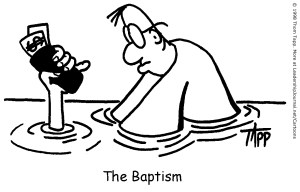
This reminded me of the discussion we are having in Confirmation about sacraments. And how in baptism the story was that when Roman soldiers were baptized they would get baptized with their right hand out of the water. The reason for this was because they used that hand for their sword and they still wanted to be able to kill. The image above is the modern spin on this story. We will give everything to God except our wallet, and when we hear stewardship that is what we think. The church just wants our money.
Well no that is not what I want when I talk about stewardship. You see Stewardship is more than money. It is being a good steward or manager of what God has placed in your care. It includes yourself, your time and all of your possessions. And Parents, you being a good steward is raising your kids in a way that God would have you do that. You see stewardship is not just about financial aspects but is a way of life. Living as a good steward is living as God has called us to be in the world.
So live your life as a good steward, managing what God has blessed you with so that all of the world may come to see the blessing they have from God also.

After this Paul left Athens and went to Corinth. There he found a Jew named Aquila, a native of Pontus, who had recently come from Italy with his wife Priscilla, because Claudius had ordered all Jews to leave Rome. Paul went to see them, and, because he was of the same trade, he stayed with them, and they worked together—by trade they were tentmakers.Every sabbath he would argue in the synagogue and would try to convince Jews and Greeks. When Silas and Timothy arrived from Macedonia, Paul was occupied with proclaiming the word, testifying to the Jews that the Messiah was Jesus. When they opposed and reviled him, in protest he shook the dust from his clothes and said to them, “Your blood be on your own heads! I am innocent. From now on I will go to the Gentiles.” Then he left the synagogue and went to the house of a man named Titius Justus, a worshiper of God; his house was next door to the synagogue.Crispus, the official of the synagogue, became a believer in the Lord, together with all his household; and many of the Corinthians who heard Paul became believers and were baptized. One night the Lord said to Paul in a vision, “Do not be afraid, but speak and do not be silent; for I am with you, and no one will lay a hand on you to harm you, for there are many in this city who are my people.” He stayed there a year and six months, teaching the word of God among them. But when Gallio was proconsul of Achaia, the Jews made a united attack on Paul and brought him before the tribunal. They said, “This man is persuading people to worship God in ways that are contrary to the law.”Just as Paul was about to speak, Gallio said to the Jews, “If it were a matter of crime or serious villainy, I would be justified in accepting the complaint of you Jews; but since it is a matter of questions about words and names and your own law, see to it yourselves; I do not wish to be a judge of these matters.” And he dismissed them from the tribunal. Then all of them seized Sosthenes, the official of the synagogue, and beat him in front of the tribunal. But Gallio paid no attention to any of these things. (Acts 18:1-17, NRSV)
Paul went where he could share the message of Jesus. And he would give it to whoever would listen. So when he met a Jew who had come from Rome and was living in Corinth and they shared the same occupation, he went with him to the temple. He told them that Jesus was the Messiah they were waiting for. And when they wouldn’t listen, Paul shook the dust off his clothes and left. He went to those who would listen.
And even then people stirred up trouble for Paul.
But in the face of everything Paul stood firm in his proclamation because he knew that God was with him,
Are you ready to walk the walk and go when God tells you, knowing He will always be with you?
 While Paul was waiting for them in Athens, he was deeply distressed to see that the city was full of idols. So he argued in the synagogue with the Jews and the devout persons, and also in the marketplace every day with those who happened to be there. Also some Epicurean and Stoic philosophers debated with him. Some said, “What does this babbler want to say?” Others said, “He seems to be a proclaimer of foreign divinities.” (This was because he was telling the good news about Jesus and the resurrection.) So they took him and brought him to the Areopagus and asked him, “May we know what this new teaching is that you are presenting? It sounds rather strange to us, so we would like to know what it means.” Now all the Athenians and the foreigners living there would spend their time in nothing but telling or hearing something new. Then Paul stood in front of the Areopagus and said, “Athenians, I see how extremely religious you are in every way. For as I went through the city and looked carefully at the objects of your worship, I found among them an altar with the inscription, ‘To an unknown god.’ What therefore you worship as unknown, this I proclaim to you. The God who made the world and everything in it, he who is Lord of heaven and earth, does not live in shrines made by human hands, nor is he served by human hands, as though he needed anything, since he himself gives to all mortals life and breath and all things. From one ancestor he made all nations to inhabit the whole earth, and he allotted the times of their existence and the boundaries of the places where they would live, so that they would search for God and perhaps grope for him and find him—though indeed he is not far from each one of us. For ‘In him we live and move and have our being’; as even some of your own poets have said, ‘For we too are his offspring.’ Since we are God’s offspring, we ought not to think that the deity is like gold, or silver, or stone, an image formed by the art and imagination of mortals. While God has overlooked the times of human ignorance, now he commands all people everywhere to repent, because he has fixed a day on which he will have the world judged in righteousness by a man whom he has appointed, and of this he has given assurance to all by raising him from the dead.” (Acts 17:16-31, NRSV)
When Paul was in Athens he was invited to speak with those who wanted to hear new ideas and thoughts. They asked Paul to tell them about his teaching.
Has anyone ever asked you about your faith?
And if they did what would you say?
How would you react?
Would you know what to say?
Paul had looked around and had seen things in their community he could speak about and help them understand who God is.
An unknown god to you, but let me tell you about who God is and how you can know Him!
How can we use clues from people’s daily lives to help them see God more clearly?
 We set sail from Troas and took a straight course to Samothrace, the following day to Neapolis, and from there to Philippi, which is a leading city of the district of Macedonia and a Roman colony. We remained in this city for some days. On the sabbath day we went outside the gate by the river, where we supposed there was a place of prayer; and we sat down and spoke to the women who had gathered there. A certain woman named Lydia, a worshiper of God, was listening to us; she was from the city of Thyatira and a dealer in purple cloth. The Lord opened her heart to listen eagerly to what was said by Paul. When she and her household were baptized, she urged us, saying, “If you have judged me to be faithful to the Lord, come and stay at my home.” And she prevailed upon us. (Acts 16:11-15, NRSV)
Did you see what happened here?
Paul went where God was leading him and shared what had happened to him and how he had met Jesus and all that Jesus did for the entire world. And when they shared the message that God sent them with, people would listen and hear and God opened the hearts of those listening and they heard the message of love.
That is what God is asking all of us to do. To go where He leads us, and share His Story with all the world. And then let Him work on the hearts of those who listen.
Are you ready to go?
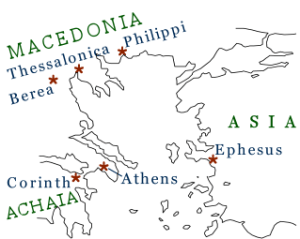 They went through the region of Phrygia and Galatia, having been forbidden by the Holy Spirit to speak the word in Asia. When they had come opposite Mysia, they attempted to go into Bithynia, but the Spirit of Jesus did not allow them; so, passing by Mysia, they went down to Troas. During the night Paul had a vision: there stood a man of Macedonia pleading with him and saying, “Come over to Macedonia and help us. ”When he had seen the vision, we immediately tried to cross over to Macedonia, being convinced that God had called us to proclaim the good news to them. (Acts 16:6-10, NRSV)
Have you ever felt like you needed to do something?
Like you had to go somewhere?
That is what happened to Paul here. Only it wasn’t just a feeling. It was a vision. God sent him a vision of a man in Macedonia asking for help. And so Paul went there.
Do we always follow through on those feelings?

 aSacredRebel