 15“If another member of the church sins against you, go and point out the fault when the two of you are alone. If the member listens to you, you have regained that one. 16But if you are not listened to, take one or two others along with you, so that every word may be confirmed by the evidence of two or three witnesses. 17If the member refuses to listen to them, tell it to the church; and if the offender refuses to listen even to the church, let such a one be to you as a Gentile and a tax collector.18Truly I tell you, whatever you bind on earth will be bound in heaven, and whatever you loose on earth will be loosed in heaven. 19Again, truly I tell you, if two of you agree on earth about anything you ask, it will be done for you by my Father in heaven. 20For where two or three are gathered in my name, I am there among them.” 21Then Peter came and said to him, “Lord, if another member of the church sins against me, how often should I forgive? As many as seven times?” 22Jesus said to him, “Not seven times, but, I tell you, seventy-seven times. 23“For this reason the kingdom of heaven may be compared to a king who wished to settle accounts with his slaves. 24When he began the reckoning, one who owed him ten thousand talents was brought to him; 25and, as he could not pay, his lord ordered him to be sold, together with his wife and children and all his possessions, and payment to be made. 26So the slave fell on his knees before him, saying, ‘Have patience with me, and I will pay you everything.’ 27And out of pity for him, the lord of that slave released him and forgave him the debt. 28But that same slave, as he went out, came upon one of his fellow slaves who owed him a hundred denarii; and seizing him by the throat, he said, ‘Pay what you owe.’ 29Then his fellow slave fell down and pleaded with him, ‘Have patience with me, and I will pay you.’ 30But he refused; then he went and threw him into prison until he would pay the debt. 31When his fellow slaves saw what had happened, they were greatly distressed, and they went and reported to their lord all that had taken place. 32Then his lord summoned him and said to him, ‘You wicked slave! I forgave you all that debt because you pleaded with me. 33Should you not have had mercy on your fellow slave, as I had mercy on you?’ 34And in anger his lord handed him over to be tortured until he would pay his entire debt. 35So my heavenly Father will also do to every one of you, if you do not forgive your brother or sister from your heart.” (Matthew 18:15-35, NRSV)
Wow. I am in deep trouble. This passage has Jesus telling us if we do not forgive others, that God will not forgive us. God will hold us accountable for every wrong we have done and make us pay back everything we owe God. Which is ultimately everything. Here a slave is forgiven a huge debt. How big was this debt?
Well in comparison the other slave owed the first 100 denarii which is the same as the pay for 100 days of work. so in about 4 months, a person could earn that amount. But 10,000 Talents is a lot more. You see a Talent is a measure of weight for gold. 1 Talent is equal to about 75 U.S. pounds. So just to give an example in today’s values, on February 22, 2019, when I typed this devotional the value of 1 ounce of Gold was $1,323.24. So 1 Talent would equal $1,587,888! and 10,000 would be $15,878,880,000! That is over 15 Billion. And the king forgave the debt when the slave begged! But that slave could not take the forgiveness he was given and give it to others because he needed what was his.
But think about what God has forgiven you. And that is worth way more than 15 Billion so we should forgive others.
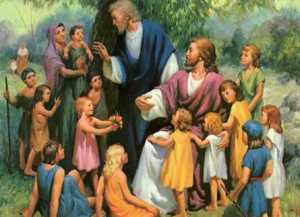 13Then little children were being brought to him in order that he might lay his hands on them and pray. The disciples spoke sternly to those who brought them; 14but Jesus said, “Let the little children come to me, and do not stop them; for it is to such as these that the kingdom of heaven belongs.” 15And he laid his hands on them and went on his way. (Matthew 19:13-15, NRSV)
 When Jesus had finished saying these things, he left Galilee and went to the region of Judea beyond the Jordan. 2Large crowds followed him, and he cured them there. 3Some Pharisees came to him, and to test him they asked, “Is it lawful for a man to divorce his wife for any cause?” 4He answered, “Have you not read that the one who made them at the beginning ‘made them male and female,’ 5and said, ‘For this reason a man shall leave his father and mother and be joined to his wife, and the two shall become one flesh’?6So they are no longer two, but one flesh. Therefore what God has joined together, let no one separate.” 7They said to him, “Why then did Moses command us to give a certificate of dismissal and to divorce her?” 8He said to them, “It was because you were so hard-hearted that Moses allowed you to divorce your wives, but from the beginning it was not so.9And I say to you, whoever divorces his wife, except for unchastity, and marries another commits adultery.” 10His disciples said to him, “If such is the case of a man with his wife, it is better not to marry.” 11But he said to them, “Not everyone can accept this teaching, but only those to whom it is given. 12For there are eunuchs who have been so from birth, and there are eunuchs who have been made eunuchs by others, and there are eunuchs who have made themselves eunuchs for the sake of the kingdom of heaven. Let anyone accept this who can.” (Matthew 19:1-12, NRSV)
 38Then some of the scribes and Pharisees said to him, “Teacher, we wish to see a sign from you.” 39But he answered them, “An evil and adulterous generation asks for a sign, but no sign will be given to it except the sign of the prophet Jonah. 40For just as Jonah was three days and three nights in the belly of the sea monster, so for three days and three nights the Son of Man will be in the heart of the earth. 41The people of Nineveh will rise up at the judgment with this generation and condemn it, because they repented at the proclamation of Jonah, and see, something greater than Jonah is here! 42The queen of the South will rise up at the judgment with this generation and condemn it, because she came from the ends of the earth to listen to the wisdom of Solomon, and see, something greater than Solomon is here! (Matthew 12:38-42, NRSV)
 22Then they brought to him a demoniac who was blind and mute; and he cured him, so that the one who had been mute could speak and see. 23All the crowds were amazed and said, “Can this be the Son of David?” 24But when the Pharisees heard it, they said, “It is only by Beelzebul, the ruler of the demons, that this fellow casts out the demons.” 25He knew what they were thinking and said to them, “Every kingdom divided against itself is laid waste, and no city or house divided against itself will stand.26If Satan casts out Satan, he is divided against himself; how then will his kingdom stand? 27If I cast out demons by Beelzebul, by whom do your own exorcists cast them out? Therefore they will be your judges.28But if it is by the Spirit of God that I cast out demons, then the kingdom of God has come to you. 29Or how can one enter a strong man’s house and plunder his property, without first tying up the strong man? Then indeed the house can be plundered. 30Whoever is not with me is against me, and whoever does not gather with me scatters. 31Therefore I tell you, people will be forgiven for every sin and blasphemy, but blasphemy against the Spirit will not be forgiven. 32Whoever speaks a word against the Son of Man will be forgiven, but whoever speaks against the Holy Spirit will not be forgiven, either in this age or in the age to come. 33“Either make the tree good, and its fruit good; or make the tree bad, and its fruit bad; for the tree is known by its fruit. 34You brood of vipers! How can you speak good things, when you are evil? For out of the abundance of the heart the mouth speaks. 35The good person brings good things out of a good treasure, and the evil person brings evil things out of an evil treasure. 36I tell you, on the day of judgment you will have to give an account for every careless word you utter; 37for by your words you will be justified, and by your words you will be condemned.” (Matthew 12:22-37, NRSV)
 10“Take care that you do not despise one of these little ones; for, I tell you, in heaven their angels continually see the face of my Father in heaven. 12What do you think? If a shepherd has a hundred sheep, and one of them has gone astray, does he not leave the ninety-nine on the mountains and go in search of the one that went astray? 13And if he finds it, truly I tell you, he rejoices over it more than over the ninety-nine that never went astray. 14So it is not the will of your Father in heaven that one of these little ones should be lost. (Matthew 18:10-14, NRSV)
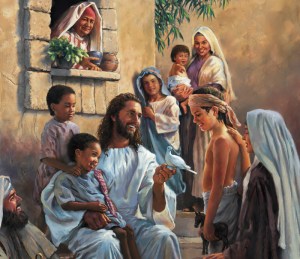 At that time the disciples came to Jesus and asked, “Who is the greatest in the kingdom of heaven?” 2He called a child, whom he put among them, 3and said, “Truly I tell you, unless you change and become like children, you will never enter the kingdom of heaven.4Whoever becomes humble like this child is the greatest in the kingdom of heaven. 5Whoever welcomes one such child in my name welcomes me.6“If any of you put a stumbling block before one of these little ones who believe in me, it would be better for you if a great millstone were fastened around your neck and you were drowned in the depth of the sea. 7Woe to the world because of stumbling blocks! Occasions for stumbling are bound to come, but woe to the one by whom the stumbling block comes! 8“If your hand or your foot causes you to stumble, cut it off and throw it away; it is better for you to enter life maimed or lame than to have two hands or two feet and to be thrown into the eternal fire. 9And if your eye causes you to stumble, tear it out and throw it away; it is better for you to enter life with one eye than to have two eyes and to be thrown into the hell of fire. (Matthew 18:1-9, NRSV)
 14When they came to the crowd, a man came to him, knelt before him,15and said, “Lord, have mercy on my son, for he is an epileptic and he suffers terribly; he often falls into the fire and often into the water. 16And I brought him to your disciples, but they could not cure him.” 17Jesus answered, “You faithless and perverse generation, how much longer must I be with you? How much longer must I put up with you? Bring him here to me.” 18And Jesus rebuked the demon, and it came out of him, and the boy was cured instantly. 19Then the disciples came to Jesus privately and said, “Why could we not cast it out?” 20He said to them, “Because of your little faith. For truly I tell you, if you have faith the size of a mustard seed, you will say to this mountain, ‘Move from here to there,’ and it will move; and nothing will be impossible for you.” (Matthew 17:14-21, NRSV)
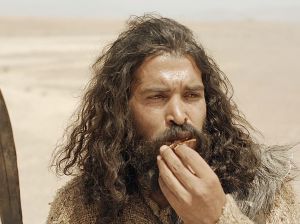 9As they were coming down the mountain, Jesus ordered them, “Tell no one about the vision until after the Son of Man has been raised from the dead.” 10And the disciples asked him, “Why, then, do the scribes say that Elijah must come first?” 11He replied, “Elijah is indeed coming and will restore all things; 12but I tell you that Elijah has already come, and they did not recognize him, but they did to him whatever they pleased. So also the Son of Man is about to suffer at their hands.” 13Then the disciples understood that he was speaking to them about John the Baptist. (Matthew 17:9-13, NRSV)
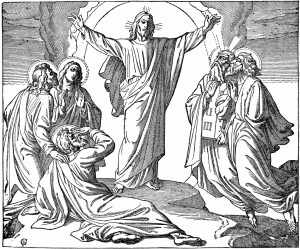 24Then Jesus told his disciples, “If any want to become my followers, let them deny themselves and take up their cross and follow me. 25For those who want to save their life will lose it, and those who lose their life for my sake will find it. 26For what will it profit them if they gain the whole world but forfeit their life? Or what will they give in return for their life? 27“For the Son of Man is to come with his angels in the glory of his Father, and then he will repay everyone for what has been done. 28Truly I tell you, there are some standing here who will not taste death before they see the Son of Man coming in his kingdom.” Six days later, Jesus took with him Peter and James and his brother John and led them up a high mountain, by themselves. 2And he was transfigured before them, and his face shone like the sun, and his clothes became dazzling white. 3Suddenly there appeared to them Moses and Elijah, talking with him. 4Then Peter said to Jesus, “Lord, it is good for us to be here; if you wish, I will make three dwellings here, one for you, one for Moses, and one for Elijah.” 5While he was still speaking, suddenly a bright cloud overshadowed them, and from the cloud a voice said, “This is my Son, the Beloved; with him I am well pleased; listen to him!” 6When the disciples heard this, they fell to the ground and were overcome by fear. 7But Jesus came and touched them, saying, “Get up and do not be afraid.” 8And when they looked up, they saw no one except Jesus himself alone. (Matthew 16:24-17:8, NRSV)
