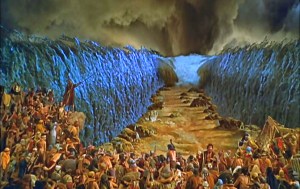
 When the king of Egypt was told that the people had fled, the minds of Pharaoh and his officials were changed toward the people, and they said, “What have we done, letting Israel leave our service?” So he had his chariot made ready, and took his army with him; he took six hundred picked chariots and all the other chariots of Egypt with officers over all of them. As Pharaoh drew near, the Israelites looked back, and there were the Egyptians advancing on them. In great fear the Israelites cried out to the Lord. They said to Moses, “Was it because there were no graves in Egypt that you have taken us away to die in the wilderness? What have you done to us, bringing us out of Egypt? Is this not the very thing we told you in Egypt, ‘Let us alone and let us serve the Egyptians’? For it would have been better for us to serve the Egyptians than to die in the wilderness.” But Moses said to the people, “Do not be afraid, stand firm, and see the deliverance that the Lord will accomplish for you today; for the Egyptians whom you see today you shall never see again. The Lord will fight for you, and you have only to keep still.” Then Moses stretched out his hand over the sea. The Lord drove the sea back by a strong east wind all night, and turned the sea into dry land; and the waters were divided. The Israelites went into the sea on dry ground, the waters forming a wall for them on their right and on their left. The Egyptians pursued, and went into the sea after them, all of Pharaoh’s horses, chariots, and chariot drivers. At the morning watch the Lord in the pillar of fire and cloud looked down upon the Egyptian army, and threw the Egyptian army into panic. He clogged their chariot wheels so that they turned with difficulty. The Egyptians said, “Let us flee from the Israelites, for the Lord is fighting for them against Egypt.” Then the Lord said to Moses, “Stretch out your hand over the sea, so that the water may come back upon the Egyptians, upon their chariots and chariot drivers.” So Moses stretched out his hand over the sea, and at dawn the sea returned to its normal depth. As the Egyptians fled before it, the Lord tossed the Egyptians into the sea. The waters returned and covered the chariots and the chariot drivers, the entire army of Pharaoh that had followed them into the sea; not one of them remained. But the Israelites walked on dry ground through the sea, the waters forming a wall for them on their right and on their left. (Exodus 14:5-7, 10-14, 21-29, NRSV)
This is an interesting story. Most of us have seen the movie, so we think of the image above of the water pushing back and becoming walls, because that is what the text says.
But what happened really and why is this story important to us as followers of Christ?
Well, the story tells us that Pharoh after the plaques let the Israelites go and after that, he thought, “What have I done, now we have no one to do our work.” So they went after the Israelites. And the Israelites were then trapped between a body of water and the approaching Egyptian army. And the Israelites whined to God and to Moses about graves in Egypt and having to die in the wilderness. But God heard them and told Moses to lift his staff and the waters would divide.
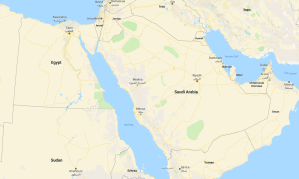 Now, how big was this body of water? The text says the red sea. Which is here:
But is that actually where the Israelites crossed? And where on the Red Sea?
What if I told you that most scholars don’t think it was the Red Sea, but a different body of water? I remember in my class on this in seminary our professor telling us the Hebrew is Sea of Reeds. So it probably isn’t the Red Sea. And my bible software shows the route of the exodus going through what is now know as Great Bitters Lake.
And Great Bitters Lake is right here.
Or here is a picture of where it is located:
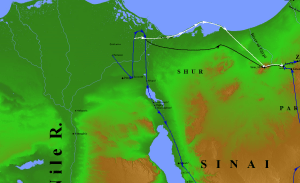
So why didn’t the Israelites go around the lake? Well, they were fleeing for their lives at this point because this huge army was coming up behind them, and they saw water in front of them, maybe for as far as they could see. So they panicked, as we often do.
And to get back to the question of why this is an important story for followers of Christ, beyond that it is part of the story that leads us to Jesus coming, it shows that God is always faithful. God led His people out of Egypt not to their death but to a land flowing with milk and honey. God upholds His promises and is faithful to His people.
Have faith that God will part the waters and help you walk on dry land. Even when it looks like all hope is lost, God will never leave you.
 On October 31, 1517 Martin Luther nailed his 95 Thesis to the door of Wittenberg Church.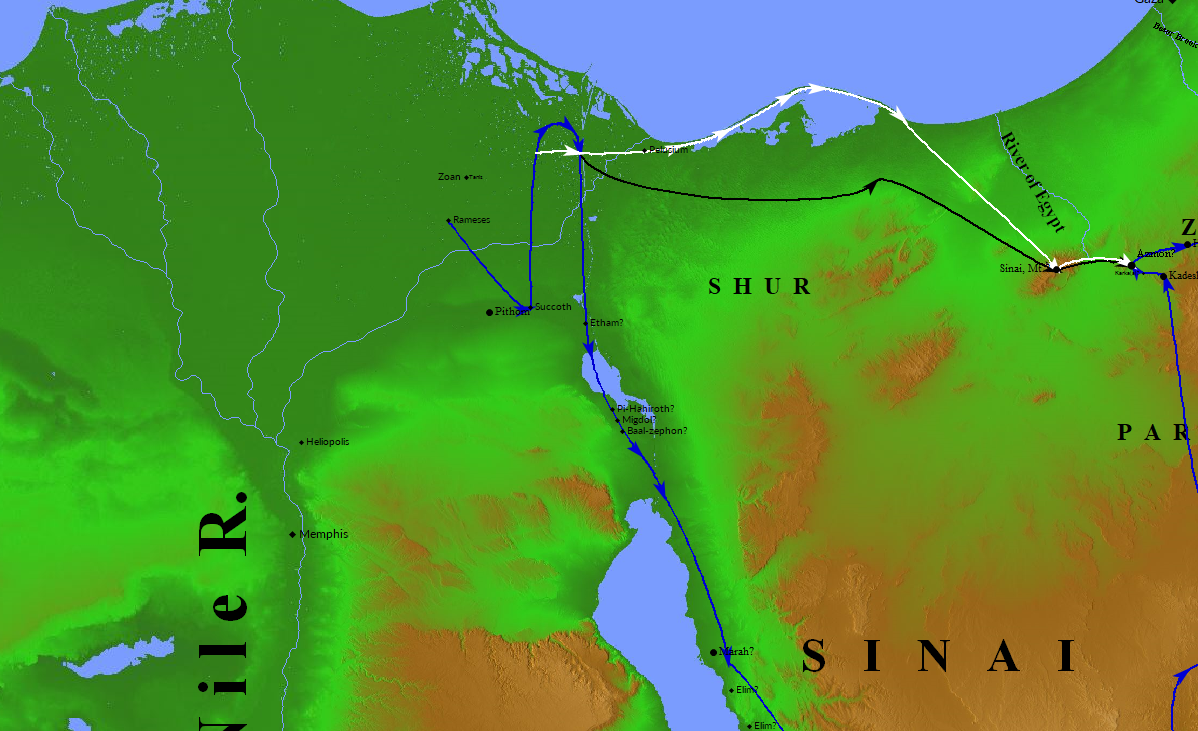
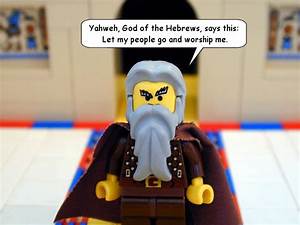 Afterward Moses and Aaron went to Pharaoh and said, “Thus says the
  Moses was keeping the flock of his father-in-law Jethro, the priest of Midian; he led his flock beyond the wilderness, and came to Horeb, the mountain of God. There the angel of the
 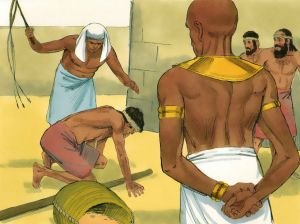 Now a new king arose over Egypt, who did not know Joseph. He said to his people, “Look, the Israelite people are more numerous and more powerful than we. Come, let us deal shrewdly with them, or they will increase and, in the event of war, join our enemies and fight against us and escape from the land.” Therefore they set taskmasters over them to oppress them with forced labor. They built supply cities, Pithom and Rameses, for Pharaoh. But the more they were oppressed, the more they multiplied and spread, so that the Egyptians came to dread the Israelites. The Egyptians became ruthless in imposing tasks on the Israelites, and made their lives bitter with hard service in mortar and brick and in every kind of field labor. They were ruthless in all the tasks that they imposed on them. (Exodus 1:8-14, NRSV)
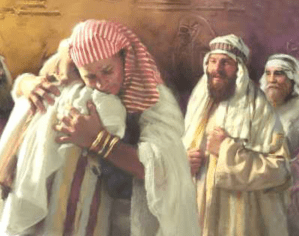 So Joseph went and told Pharaoh, “My father and my brothers, with their flocks and herds and all that they possess, have come from the land of Canaan; they are now in the land of Goshen.” From among his brothers he took five men and presented them to Pharaoh. Pharaoh said to his brothers, “What is your occupation?” And they said to Pharaoh, “Your servants are shepherds, as our ancestors were.” They said to Pharaoh, “We have come to reside as aliens in the land; for there is no pasture for your servants’ flocks because the famine is severe in the land of Canaan. Now, we ask you, let your servants settle in the land of Goshen.” Then Pharaoh said to Joseph, “Your father and your brothers have come to you. The land of Egypt is before you; settle your father and your brothers in the best part of the land; let them live in the land of Goshen; and if you know that there are capable men among them, put them in charge of my livestock.” Then Joseph brought in his father Jacob, and presented him before Pharaoh, and Jacob blessed Pharaoh. Pharaoh said to Jacob, “How many are the years of your life?” Jacob said to Pharaoh, “The years of my earthly sojourn are one hundred thirty; few and hard have been the years of my life. They do not compare with the years of the life of my ancestors during their long sojourn.” Then Jacob blessed Pharaoh, and went out from the presence of Pharaoh. Joseph settled his father and his brothers, and granted them a holding in the land of Egypt, in the best part of the land, in the land of Rameses, as Pharaoh had instructed. And Joseph provided his father, his brothers, and all his father’s household with food, according to the number of their dependents. (Genesis 47:1-12, NRSV)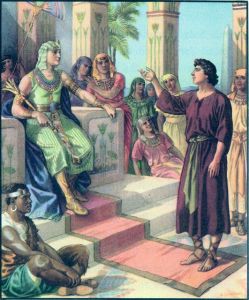
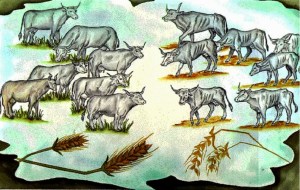 After two whole years, Pharaoh dreamed that he was standing by the Nile, and there came up out of the Nile seven sleek and fat cows, and they grazed in the reed grass. Then seven other cows, ugly and thin, came up out of the Nile after them, and stood by the other cows on the bank of the Nile. The ugly and thin cows ate up the seven sleek and fat cows. And Pharaoh awoke. Then he fell asleep and dreamed a second time; seven ears of grain, plump and good, were growing on one stalk. Then seven ears, thin and blighted by the east wind, sprouted after them. The thin ears swallowed up the seven plump and full ears. Pharaoh awoke, and it was a dream. In the morning his spirit was troubled; so he sent and called for all the magicians of Egypt and all its wise men. Pharaoh told them his dreams, but there was no one who could interpret them to Pharaoh. Then the chief cupbearer said to Pharaoh, “I remember my faults today. Once Pharaoh was angry with his servants, and put me and the chief baker in custody in the house of the captain of the guard. We dreamed on the same night, he and I, each having a dream with its own meaning. A young Hebrew was there with us, a servant of the captain of the guard. When we told him, he interpreted our dreams to us, giving an interpretation to each according to his dream. As he interpreted to us, so it turned out; I was restored to my office, and the baker was hanged.” (Genesis 41:1-13, NRSV)
 Now Joseph was taken down to Egypt, and Potiphar, an officer of Pharaoh, the captain of the guard, an Egyptian, bought him from the Ishmaelites who had brought him down there. The
 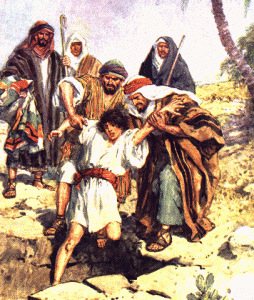 Then they sat down to eat, and looking up they saw a caravan of Ishmaelites coming from Gilead, with their camels carrying gum, balm, and resin, on their way to carry it down to Egypt. Then Judah said to his brothers, “What profit is it if we kill our brother and conceal his blood? Come, let us sell him to the Ishmaelites, and not lay our hands on him, for he is our brother, our own flesh.” And his brothers agreed. When some Midianite traders passed by, they drew Joseph up, lifting him out of the pit, and sold him to the Ishmaelites for twenty pieces of silver. And they took Joseph to Egypt. When Reuben returned to the pit and saw that Joseph was not in the pit, he tore his clothes. He returned to his brothers, and said, “The boy is gone; and I, where can I turn?” Then they took Joseph’s robe, slaughtered a goat, and dipped the robe in the blood. They had the long robe with sleeves taken to their father, and they said, “This we have found; see now whether it is your son’s robe or not.” He recognized it, and said, “It is my son’s robe! A wild animal has devoured him; Joseph is without doubt torn to pieces.” Then Jacob tore his garments, and put sackcloth on his loins, and mourned for his son many days. All his sons and all his daughters sought to comfort him; but he refused to be comforted, and said, “No, I shall go down to Sheol to my son, mourning.” Thus his father bewailed him. Meanwhile the Midianites had sold him in Egypt to Potiphar, one of Pharaoh’s officials, the captain of the guard. (Genesis 37:25-36, NRSV)
 aSacredRebel