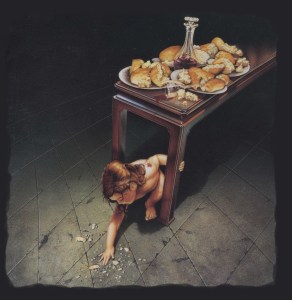
 From there he set out and went away to the region of Tyre. He entered a house and did not want anyone to know he was there. Yet he could not escape notice, but a woman whose little daughter had an unclean spirit immediately heard about him, and she came and bowed down at his feet. Now the woman was a Gentile, of Syrophoenician origin. She begged him to cast the demon out of her daughter. He said to her, “Let the children be fed first, for it is not fair to take the children’s food and throw it to the dogs.” But she answered him, “Sir, even the dogs under the table eat the children’s crumbs.” Then he said to her, “For saying that, you may go—the demon has left your daughter.” So she went home, found the child lying on the bed, and the demon gone. Then he returned from the region of Tyre, and went by way of Sidon towards the Sea of Galilee, in the region of the Decapolis. They brought to him a deaf man who had an impediment in his speech; and they begged him to lay his hand on him. He took him aside in private, away from the crowd, and put his fingers into his ears, and he spat and touched his tongue. Then looking up to heaven, he sighed and said to him, “Ephphatha,” that is, “Be opened.” And immediately his ears were opened, his tongue was released, and he spoke plainly. Then Jesus ordered them to tell no one; but the more he ordered them, the more zealously they proclaimed it. They were astounded beyond measure, saying, “He has done everything well; he even makes the deaf to hear and the mute to speak.” (Mark 7:24-37, NRSV)
I have always been intrigued by this passage. Jesus calling someone a dog because of their origin. Sounds racist. And that is a really touchy subject now…
But as one of my friends on Facebook said, “If you are preaching Jesus as a racist this Sunday, I’m not even sure what to say to you, except, I hope I’m not in your pew.”
And this story is not about Jesus being a racist, it is about a big table in a big house where everyone can come and eat.
What are the rituals you remember from eating special meals, or everyday meals?
Who prays?
What prayer is said?
Does someone always get a plate first?
Do people always sit in the same place?
What happens when someone new joins the meal?
There are so many things around meals that we take for granted until the boat, or table is rocked.
For instance I have 2 cats, ones name is Kata and he is an orange tabby, and then there is Katy a grey princess. When we feed the cats, whoever feeds them, if both of them are in the room, Katy will back away and let Kata eat first, but when the water is put down, Katy gets that first. Which is very interesting, because if there is an alpha, it is Katy. But she does not eat first. Why? Because that is how it is…
And to Jews in Jesus day Syrophoenicians were dogs. But Jesus did not say this because he believed it, maybe it was a test, I don’t know.
But once her faith was made known, He made known she was welcome.
My friend on Facebook went on to say, “I think we read it as if we’re not the ones getting the crumbs, but were all gentiles. So, I think that changes how you read it. It’s not a story of xenophobia, but a story of the grafting of the gentiles. Jesus came for the Jews first, then Gentiles.”
You see Jesus came to set the house of Israel straight. To teach them how to live the life God had called them to, but then He was also to feed the Gentiles, the rest of the people, and that is where we fit. We are Gentiles, and therefore dogs. But we get the scraps, the crumbs from the table and there is enough Grace in the crumbs to save a sinner like me.
So go into the world with the many blessings God has given you not to hoard them, but to share them, because God will give you more crumbs!
 Shall not Lebanon in a very little while






 Now when the Pharisees and some of the scribes who had come from Jerusalem gathered around him, they noticed that some of his disciples were eating with defiled hands, that is, without washing them. (For the Pharisees, and all the Jews, do not eat unless they thoroughly wash their hands, thus observing the tradition of the elders; and they do not eat anything from the market unless they wash it; and there are also many other traditions that they observe, the washing of cups, pots, and bronze kettles.) So the Pharisees and the scribes asked him, “Why do your disciples not live according to the tradition of the elders, but eat with defiled hands?” He said to them, “Isaiah prophesied rightly about you hypocrites, as it is written, ‘This people honors me with their lips, but their hearts are far from me; in vain do they worship me, teaching human precepts as doctrines.’ You abandon the commandment of God and hold to human tradition.” Then he called the crowd again and said to them, “Listen to me, all of you, and understand: there is nothing outside a person that by going in can defile, but the things that come out are what defile.” For it is from within, from the human heart, that evil intentions come: fornication, theft, murder, adultery, avarice, wickedness, deceit, licentiousness, envy, slander, pride, folly. All these evil things come from within, and they defile a person.” (Mark 7:1-8, 14-15, 21-23, NRSV)
