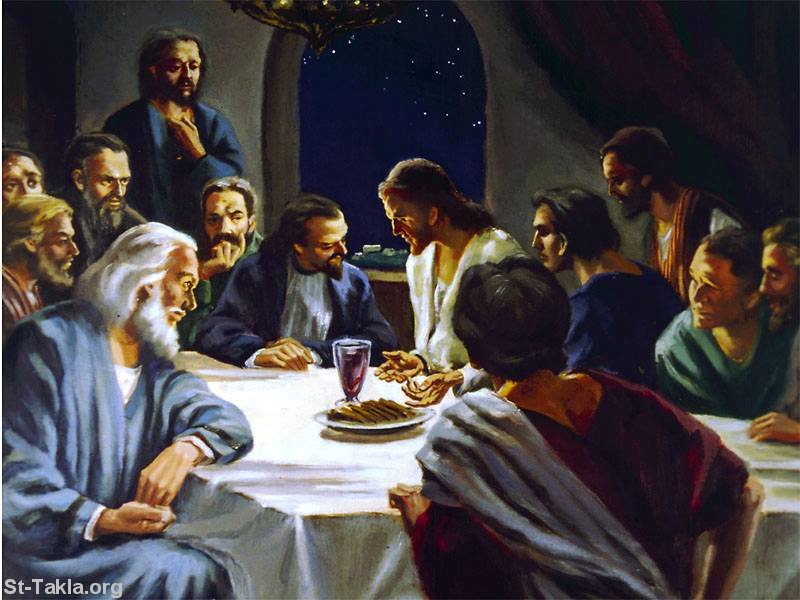
 On the first day of Unleavened Bread, when the Passover lamb is sacrificed, his disciples said to him, “Where do you want us to go and make the preparations for you to eat the Passover?” So he sent two of his disciples, saying to them, “Go into the city, and a man carrying a jar of water will meet you; follow him, and wherever he enters, say to the owner of the house, ‘The Teacher asks, Where is my guest room where I may eat the Passover with my disciples?’ He will show you a large room upstairs, furnished and ready. Make preparations for us there.” So the disciples set out and went to the city, and found everything as he had told them; and they prepared the Passover meal. When it was evening, he came with the twelve. And when they had taken their places and were eating, Jesus said, “Truly I tell you, one of you will betray me, one who is eating with me.” They began to be distressed and to say to him one after another, “Surely, not I?” He said to them, “It is one of the twelve, one who is dipping bread into the bowl with me. (Mark 14:12-20, NRSV)
One of you will paradidomi me…
Doesn’t quite work does it. Jesus at the last supper said one of you will betray me, is the translation we often here and have learned.
Judas betrayed Jesus. Does that mean Jesus didn’t know what was going to happen? In another gospel in the garden, Jesus asks Judas, “Do you betray me with a kiss?” That is not the question of one who does not know what is happening.
So if Judas didn’t betray Jesus what did he do?
paradidomi is the Greek word used in all the gospels in this moment, and it means to give over, hand over, deliver up… Not betray in the sense that Judas was doing something that Jesus did not know was going to happen.
Jesus knew. Judas did his part.
Not betrayed. Handed over.
 It was two days before the Passover and the festival of Unleavened Bread. The chief priests and the scribes were looking for a way to arrest Jesus by stealth and kill him; for they said, “Not during the festival, or there may be a riot among the people.” While he was at Bethany in the house of Simon the leper, as he sat at the table, a woman came with an alabaster jar of very costly ointment of nard, and she broke open the jar and poured the ointment on his head. But some were there who said to one another in anger, “Why was the ointment wasted in this way? For this ointment could have been sold for more than three hundred denarii, and the money given to the poor.” And they scolded her. But Jesus said, “Let her alone; why do you trouble her? She has performed a good service for me. For you always have the poor with you, and you can show kindness to them whenever you wish; but you will not always have me. She has done what she could; she has anointed my body beforehand for its burial. Truly I tell you, wherever the good news is proclaimed in the whole world, what she has done will be told in remembrance of her.” Then Judas Iscariot, who was one of the twelve, went to the chief priests in order to betray him to them. When they heard it, they were greatly pleased, and promised to give him money. So he began to look for an opportunity to betray him. (Mark 14:1-11, NRSV)




 aSacredRebel