Thoughts from a friend that are worth reading!
worry
 “Therefore I tell you, do not worry about your life, what you will eat or what you will drink, or about your body, what you will wear. Is not life more than food, and the body more than clothing? Look at the birds of the air; they neither sow nor reap nor gather into barns, and yet your heavenly Father feeds them. Are you not of more value than they? And can any of you by worrying add a single hour to your span of life? And why do you worry about clothing? Consider the lilies of the field, how they grow; they neither toil nor spin, yet I tell you, even Solomon in all his glory was not clothed like one of these. But if God so clothes the grass of the field, which is alive today and tomorrow is thrown into the oven, will he not much more clothe you—you of little faith? Therefore do not worry, saying, ‘What will we eat?’ or ‘What will we drink?’ or ‘What will we wear?’ For it is the Gentiles who strive for all these things; and indeed your heavenly Father knows that you need all these things. But strive first for the kingdom of God and his righteousness, and all these things will be given to you as well. (Matthew 6:25-33, NRSV)
Do not worry because you can not change the thing you are worrying about or add any time to your life or the lives of others.
The birds are clothed and have food. God provides for them, and He will provide for you.
All things will be given!
Worrying can not add time, or change the world, only God can do that. So trust God and you will have all you need!
what you need
 His divine power has given us everything needed for life and godliness, through the knowledge of him who called us by his own glory and goodness. Thus he has given us, through these things, his precious and very great promises, so that through them you may escape from the corruption that is in the world because of lust, and may become participants of the divine nature. For this very reason, you must make every effort to support your faith with goodness, and goodness with knowledge, and knowledge with self-control, and self-control with endurance, and endurance with godliness, and godliness with mutual affection, and mutual affection with love. For if these things are yours and are increasing among you, they keep you from being ineffective and unfruitful in the knowledge of our Lord Jesus Christ. For anyone who lacks these things is nearsighted and blind, and is forgetful of the cleansing of past sins. Therefore, brothers and sisters, be all the more eager to confirm your call and election, for if you do this, you will never stumble. For in this way, entry into the eternal kingdom of our Lord and Savior Jesus Christ will be richly provided for you. (2 Peter 1:3-11, NRSV)
Everything we need has been provided to us through faith.
So support your faith with goodness, and through goodness gain knowledge, and through knowledge gain self-control and through self-control gain endurance, and through endurance gain godliness and through godliness gain mutual affection and through mutual affection gain love.
And in love show forth your faith to the world, so all might see and know that God loves you and them.
free
 Ho, everyone who thirsts,
come to the waters;
and you that have no money,
come, buy and eat!
Come, buy wine and milk
without money and without price.
Why do you spend your money for that which is not bread,
and your labor for that which does not satisfy?
Listen carefully to me, and eat what is good,
and delight yourselves in rich food.
Incline your ear, and come to me;
listen, so that you may live.
I will make with you an everlasting covenant,
my steadfast, sure love for David.
See, I made him a witness to the peoples,
a leader and commander for the peoples.
See, you shall call nations that you do not know,
and nations that do not know you shall run to you,
because of the LORD your God, the Holy One of Israel,
for he has glorified you.
Seek the LORD while he may be found,
call upon him while he is near;
(Isaiah 55:1-6, NRSV)
come and buy milk and wine and food to eat with no price!
For the Lord your God, the Holy one of Israel, has glorified you.
He has made an everlasting covenant with Israel and with you and He will give you what you need.
So relax and rest in Him, knowing He will provide for you.
a visit
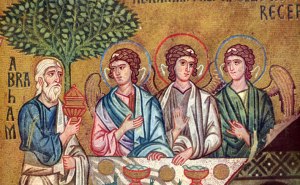 The LORD appeared to Abraham by the oaks of Mamre, as he sat at the entrance of his tent in the heat of the day. He looked up and saw three men standing near him. When he saw them, he ran from the tent entrance to meet them, and bowed down to the ground. He said, “My lord, if I find favor with you, do not pass by your servant. Let a little water be brought, and wash your feet, and rest yourselves under the tree. Let me bring a little bread, that you may refresh yourselves, and after that you may pass on—since you have come to your servant.” So they said, “Do as you have said.” And Abraham hastened into the tent to Sarah, and said, “Make ready quickly three measures of choice flour, knead it, and make cakes.” Abraham ran to the herd, and took a calf, tender and good, and gave it to the servant, who hastened to prepare it. Then he took curds and milk and the calf that he had prepared, and set it before them; and he stood by them under the tree while they ate. They said to him, “Where is your wife Sarah?” And he said, “There, in the tent.” Then one said, “I will surely return to you in due season, and your wife Sarah shall have a son.” (Genesis 18:1-10a, NRSV)
So how does one prepare for a visit from angels?
Well you must have curds, especially if you are from Wisconsin!
But you make fresh cakes, and kill a fatted calf. You prepare a fine meal for all to enjoy.
Abraham and Sarah entertained the angels. They did for them what they would do for any guests.
So how would you entertain angels?
Because we entertain angels every day!
How many things do you need?
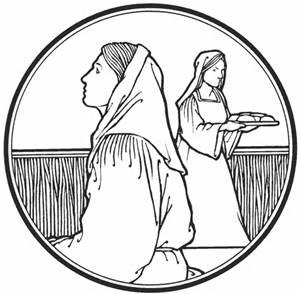 Now as they went on their way, he entered a certain village, where a woman named Martha welcomed him into her home. She had a sister named Mary, who sat at the Lord’s feet and listened to what he was saying. But Martha was distracted by her many tasks; so she came to him and asked, “Lord, do you not care that my sister has left me to do all the work by myself? Tell her then to help me.” But the Lord answered her, “Martha, Martha, you are worried and distracted by many things; there is need of only one thing. Mary has chosen the better part, which will not be taken away from her.” (Luke 10:38-42, NRSV)
Have you ever been someplace doing all of the work, while someone else, who should have been helping was sitting and listening to what was happening?
Have you ever resented family members who didn’t help when there were chores to be done?
Jesus told Martha who was worried about getting all of the house work done, that it will be there later. And right now we need to be with me. Mary chose to sit at Jesus’ feet and listen, a place that was not open to woman, but Jesus knew that is where Mary and Martha should be.
Martha wanted the work done, but her focus was off. Jesus said to focus on Him.
When we chose to focus on Jesus the rest of the will fall into place.
So how many things do you need?
Really only 1, just focus on Jesus.
fast
 Is not this the fast that I choose:
to loose the bonds of injustice,
to undo the thongs of the yoke,
to let the oppressed go free,
and to break every yoke?
Is it not to share your bread with the hungry,
and bring the homeless poor into your house;
when you see the naked, to cover them,
and not to hide yourself from your own kin?
Then your light shall break forth like the dawn,
and your healing shall spring up quickly;
your vindicator shall go before you,
the glory of the LORD shall be your rear guard.
Then you shall call, and the LORD will answer;
you shall cry for help, and he will say, Here I am.
If you remove the yoke from among you,
the pointing of the finger, the speaking of evil,
if you offer your food to the hungry
and satisfy the needs of the afflicted,
then your light shall rise in the darkness
and your gloom be like the noonday.
The LORD will guide you continually,
and satisfy your needs in parched places,
and make your bones strong;
and you shall be like a watered garden,
like a spring of water,
whose waters never fail.
(Isaiah 58:6-11, NRSV)
The fast that God wants is not one that makes us look like we are doing anything, but one that will loose the bonds of injustice, to undo the thongs of the yoke, to let the oppressed go free, and to break every yoke?
We need to undo injustice, set the oppressed free and break every yoke.
Give to those in need and stop pointing fingers.
Judge not and love as God loved us.
fulfilling the law
 Owe no one anything, except to love one another; for the one who loves another has fulfilled the law. The commandments, “You shall not commit adultery; You shall not murder; You shall not steal; You shall not covet”; and any other commandment, are summed up in this word, “Love your neighbor as yourself.” Love does no wrong to a neighbor; therefore, love is the fulfilling of the law. (Romans 13:8-10, NRSV)
Love does no wrong to anyone. Love is the fulfilling of the law.
The only thing we owe others is what God gave to us, unconditional love.
So love everyone as God loved you.
2 great Commandments
 One of the scribes came near and heard them disputing with one another, and seeing that he answered them well, he asked him, “Which commandment is the first of all?” Jesus answered, “The first is, ‘Hear, O Israel: the Lord our God, the Lord is one; you shall love the Lord your God with all your heart, and with all your soul, and with all your mind, and with all your strength.’ The second is this, ‘You shall love your neighbor as yourself.’ There is no other commandment greater than these.” Then the scribe said to him, “You are right, Teacher; you have truly said that ‘he is one, and besides him there is no other’; and ‘to love him with all the heart, and with all the understanding, and with all the strength,’ and ‘to love one’s neighbor as oneself,’—this is much more important than all whole burnt offerings and sacrifices.” When Jesus saw that he answered wisely, he said to him, “You are not far from the kingdom of God.” After that no one dared to ask him any question. (Mark 12:28-34, NRSV)
What is the greatest commandment?
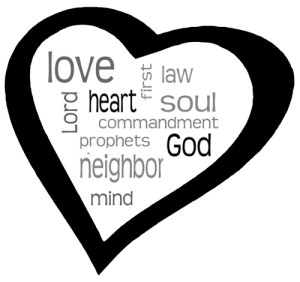
Love the Lord your God with all your heart, soul and mind, and the second is like it, love you neighbor as yourself.
These 2 commandments actually sum up all of the Law and the Prophets.
They are a Readers Digest version of the Hebrew Scripture.
If you love God and neighbor you will fulfill the sum of the Law, not that this will save you because Christ did that on the cross, but this will show the world the love of God.
works
 What good is it, my brothers and sisters, if you say you have faith but do not have works? Can faith save you? If a brother or sister is naked and lacks daily food, and one of you says to them, “Go in peace; keep warm and eat your fill,” and yet you do not supply their bodily needs, what is the good of that? So faith by itself, if it has no works, is dead. But someone will say, “You have faith and I have works.” Show me your faith apart from your works, and I by my works will show you my faith. You believe that God is one; you do well. Even the demons believe—and shudder. Do you want to be shown, you senseless person, that faith apart from works is barren? Was not our ancestor Abraham justified by works when he offered his son Isaac on the altar? You see that faith was active along with his works, and faith was brought to completion by the works. Thus the scripture was fulfilled that says, “Abraham believed God, and it was reckoned to him as righteousness,” and he was called the friend of God. You see that a person is justified by works and not by faith alone. Likewise, was not Rahab the prostitute also justified by works when she welcomed the messengers and sent them out by another road? For just as the body without the spirit is dead, so faith without works is also dead. (James 2:14-26, NRSV)
I have to say as a Lutheran I have problems with this passage of scripture.
Because yes we are justified by faith. And faith alone saves us.
But I also remember that all of scripture is good for teaching and reproof. So there is something to this faith without works is dead.
You see as Lutherans we are quick to quote Ephesians 2:8-9:
8 For by grace you have been saved through faith, and this is not your own doing; it is the gift of God— 9 not the result of works, so that no one may boast.
We want to say we are saved by grace through faith, and it is not by anything that I have done so we can not boast about how good of a follower of Christ I am. It is all up to Christ.
But we stop at verse 9 and we can’t do that. You see verse 10 says:
10 For we are what he has made us, created in Christ Jesus for good works, which God prepared beforehand to be our way of life.
Yes we are saved by grace through faith, and it is all Christ’s doing, but He saved us, to do the works God prepared for us to do before we were saved! You see faith without works is dead.
We don’t do works to show God we are good enough, we do works to show the world how much God loves them.
So work for God, not for your salvation, but so that the world will see Him in you!

