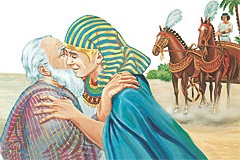
 So they went up out of Egypt and came to their father Jacob in the land of Canaan. And they told him, “Joseph is still alive! He is even ruler over all the land of Egypt.” He was stunned; he could not believe them. But when they told him all the words of Joseph that he had said to them, and when he saw the wagons that Joseph had sent to carry him, the spirit of their father Jacob revived. Israel said, “Enough! My son Joseph is still alive. I must go and see him before I die.” When Israel set out on his journey with all that he had and came to Beer-sheba, he offered sacrifices to the God of his father Isaac. God spoke to Israel in visions of the night, and said, “Jacob, Jacob.” And he said, “Here I am.” Then he said, “I am God, the God of your father; do not be afraid to go down to Egypt, for I will make of you a great nation there. I myself will go down with you to Egypt, and I will also bring you up again; and Joseph’s own hand shall close your eyes.” Then Jacob set out from Beer-sheba; and the sons of Israel carried their father Jacob, their little ones, and their wives, in the wagons that Pharaoh had sent to carry him. They also took their livestock and the goods that they had acquired in the land of Canaan, and they came into Egypt, Jacob and all his offspring with him, his sons, and his sons’ sons with him, his daughters, and his sons’ daughters; all his offspring he brought with him into Egypt. Now these are the names of the Israelites, Jacob and his offspring, who came to Egypt. Reuben, Jacob’s firstborn, and the children of Reuben: Hanoch, Pallu, Hezron, and Carmi. The children of Simeon: Jemuel, Jamin, Ohad, Jachin, Zohar, and Shaul, the son of a Canaanite woman. The children of Levi: Gershon, Kohath, and Merari. The children of Judah: Er, Onan, Shelah, Perez, and Zerah (but Er and Onan died in the land of Canaan); and the children of Perez were Hezron and Hamul. The children of Issachar: Tola, Puvah, Jashub, and Shimron. The children of Zebulun: Sered, Elon, and Jahleel (these are the sons of Leah, whom she bore to Jacob in Paddan-aram, together with his daughter Dinah; in all his sons and his daughters numbered thirty-three). The children of Gad: Ziphion, Haggi, Shuni, Ezbon, Eri, Arodi, and Areli. The children of Asher: Imnah, Ishvah, Ishvi, Beriah, and their sister Serah. The children of Beriah: Heber and Malchiel (these are the children of Zilpah, whom Laban gave to his daughter Leah; and these she bore to Jacob—sixteen persons). The children of Jacob’s wife Rachel: Joseph and Benjamin. To Joseph in the land of Egypt were born Manasseh and Ephraim, whom Asenath daughter of Potiphera, priest of On, bore to him. The children of Benjamin: Bela, Becher, Ashbel, Gera, Naaman, Ehi, Rosh, Muppim, Huppim, and Ard (these are the children of Rachel, who were born to Jacob—fourteen persons in all). The children of Dan: Hashum. The children of Naphtali: Jahzeel, Guni, Jezer, and Shillem (these are the children of Bilhah, whom Laban gave to his daughter Rachel, and these she bore to Jacob—seven persons in all). All the persons belonging to Jacob who came into Egypt, who were his own offspring, not including the wives of his sons, were sixty-six persons in all. The children of Joseph, who were born to him in Egypt, were two; all the persons of the house of Jacob who came into Egypt were seventy. Israel sent Judah ahead to Joseph to lead the way before him into Goshen. When they came to the land of Goshen, Joseph made ready his chariot and went up to meet his father Israel in Goshen. He presented himself to him, fell on his neck, and wept on his neck a good while. Israel said to Joseph, “I can die now, having seen for myself that you are still alive.” (Genesis 45:25-46:30, NRSV)
Can you imagine thinking your child was dead and then discovering they were alive and well. How would you feel? Much like Israel, it was a drop everything and go. I have to go and see them.
And when Israel finally sees him, he says, “I can die now.” My world is complete again, and so I am ready to go. I can not imagine the feeling, can you?
But know that is how God feels about us when we turn around and find Him there looking for us. We complete His world. He loves you that much.
 Six days before the Passover Jesus came to Bethany, the home of Lazarus, whom he had raised from the dead. There they gave a dinner for him. Martha served, and Lazarus was one of those at the table with him. Mary took a pound of costly perfume made of pure nard, anointed Jesus’ feet, and wiped them with her hair. The house was filled with the fragrance of the perfume. But Judas Iscariot, one of his disciples (the one who was about to betray him), said, “Why was this perfume not sold for three hundred denarii and the money given to the poor?” (He said this not because he cared about the poor, but because he was a thief; he kept the common purse and used to steal what was put into it.) Jesus said, “Leave her alone. She bought it so that she might keep it for the day of my burial. You always have the poor with you, but you do not always have me.” (John 12:1-8, NRSV)
 Truly God is good to the upright, to those who are pure in heart. But as for me, my feet had almost stumbled; my steps had nearly slipped. For I was envious of the arrogant; I saw the prosperity of the wicked. For they have no pain; their bodies are sound and sleek. They are not in trouble as others are; they are not plagued like other people. Therefore pride is their necklace; violence covers them like a garment. Their eyes swell out with fatness; their hearts overflow with follies. They scoff and speak with malice; loftily they threaten oppression. They set their mouths against heaven, and their tongues range over the earth. Therefore the people turn and praise them, and find no fault in them. And they say, “How can God know? Is there knowledge in the Most High?” Such are the wicked; always at ease, they increase in riches. All in vain I have kept my heart clean and washed my hands in innocence. For all day long I have been plagued, and am punished every morning. If I had said, “I will talk on in this way,” I would have been untrue to the circle of your children. But when I thought how to understand this, it seemed to me a wearisome task, until I went into the sanctuary of God; then I perceived their end. Truly you set them in slippery places; you make them fall to ruin. How they are destroyed in a moment, swept away utterly by terrors! They are like a dream when one awakes; on awaking you despise their phantoms. When my soul was embittered, when I was pricked in heart, I was stupid and ignorant; I was like a brute beast toward you. Nevertheless I am continually with you; you hold my right hand. You guide me with your counsel, and afterward you will receive me with honor. Whom have I in heaven but you? And there is nothing on earth that I desire other than you. My flesh and my heart may fail, but God is the strength of my heart and my portion forever. Indeed, those who are far from you will perish; you put an end to those who are false to you. But for me it is good to be near God; I have made the Lord GOD my refuge, to tell of all your works. (Psalm 73, NRSV)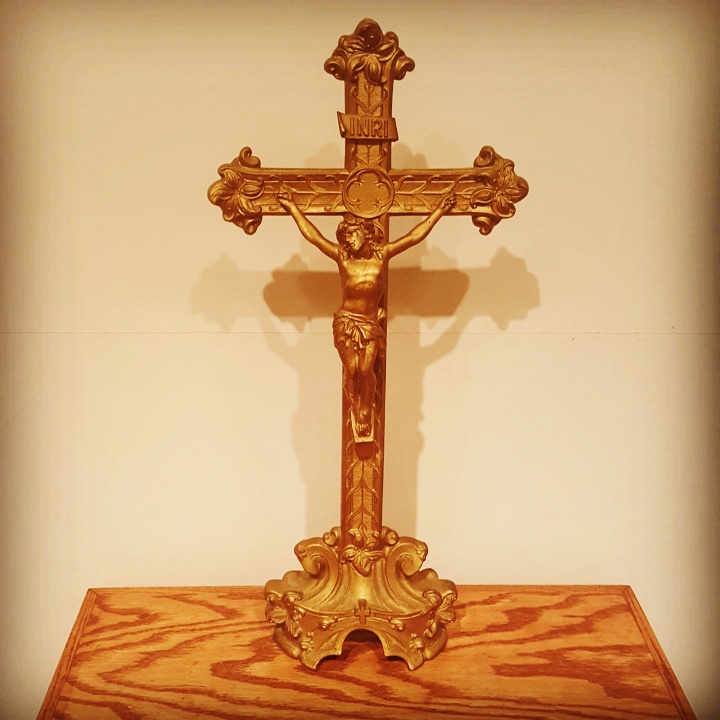
 For while we were still weak, at the right time Christ died for the ungodly. Indeed, rarely will anyone die for a righteous person—though perhaps for a good person someone might actually dare to die. But God proves his love for us in that while we still were sinners Christ died for us. Much more surely then, now that we have been justified by his blood, will we be saved through him from the wrath of God. For if while we were enemies, we were reconciled to God through the death of his Son, much more surely, having been reconciled, will we be saved by his life. But more than that, we even boast in God through our Lord Jesus Christ, through whom we have now received reconciliation. (Romans 5:6-11, NRSV)
 So he told them this parable: ‘Which one of you, having a hundred sheep and losing one of them, does not leave the ninety-nine in the wilderness and go after the one that is lost until he finds it? When he has found it, he lays it on his shoulders and rejoices. And when he comes home, he calls together his friends and neighbors, saying to them, “Rejoice with me, for I have found my sheep that was lost.” Just so, I tell you, there will be more joy in heaven over one sinner who repents than over ninety-nine righteous people who need no repentance. (Luke 15:3-7, NRSV)

 aSacredRebel