worry
 “Therefore I tell you, do not worry about your life, what you will eat or what you will drink, or about your body, what you will wear. Is not life more than food, and the body more than clothing? Look at the birds of the air; they neither sow nor reap nor gather into barns, and yet your heavenly Father feeds them. Are you not of more value than they? And can any of you by worrying add a single hour to your span of life? And why do you worry about clothing? Consider the lilies of the field, how they grow; they neither toil nor spin, yet I tell you, even Solomon in all his glory was not clothed like one of these. But if God so clothes the grass of the field, which is alive today and tomorrow is thrown into the oven, will he not much more clothe you—you of little faith? Therefore do not worry, saying, ‘What will we eat?’ or ‘What will we drink?’ or ‘What will we wear?’For it is the Gentiles who strive for all these things; and indeed your heavenly Father knows that you need all these things. But strive first for the kingdom of God and his righteousness, and all these things will be given to you as well. “So do not worry about tomorrow, for tomorrow will bring worries of its own. Today’s trouble is enough for today. (Matthew 6:25-34, NRSV)
Easy to say don’t worry about what you will eat or wear, but as an adult who is responsible for young people, you worry. You worry about what they will eat and will the money be there to pay for the housing they live in. We worry about these things. And God tells us not to.
We can trust that as He provides for the birds that neither plant nor toil, but have plenty, and the flowers of the field which are beautiful beyond anything else, God provides for these, He will provide for us.
So do not worry. God will provide what you need.
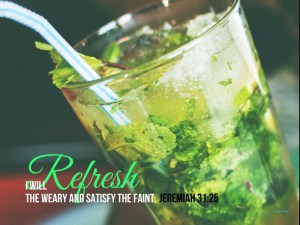
refresh
 At that time, says the Lord, I will be the God of all the families of Israel, and they shall be my people. Thus says the Lord: The people who survived the sword found grace in the wilderness; when Israel sought for rest, the Lord appeared to him from far away. I have loved you with an everlasting love; therefore I have continued my faithfulness to you. Again I will build you, and you shall be built, O virgin Israel! Again you shall take your tambourines, and go forth in the dance of the merrymakers.Again you shall plant vineyards on the mountains of Samaria; the planters shall plant, and shall enjoy the fruit. For there shall be a day when sentinels will call in the hill country of Ephraim: “Come, let us go up to Zion, to the Lord our God.” For thus says the Lord: Sing aloud with gladness for Jacob, and raise shouts for the chief of the nations; proclaim, give praise, and say, “Save, O Lord, your people, the remnant of Israel.”See, I am going to bring them from the land of the north, and gather them from the farthest parts of the earth, among them the blind and the lame, those with child and those in labor, together; a great company, they shall return here. With weeping they shall come, and with consolations I will lead them back, I will let them walk by brooks of water, in a straight path in which they shall not stumble; for I have become a father to Israel, and Ephraim is my firstborn. Hear the word of the Lord, O nations, and declare it in the coastlands far away; say, “He who scattered Israel will gather him, and will keep him as a shepherd a flock.” For the Lord has ransomed Jacob, and has redeemed him from hands too strong for him. They shall come and sing aloud on the height of Zion, and they shall be radiant over the goodness of the Lord, over the grain, the wine, and the oil, and over the young of the flock and the herd; their life shall become like a watered garden, and they shall never languish again. Then shall the young women rejoice in the dance, and the young men and the old shall be merry. I will turn their mourning into joy, I will comfort them, and give them gladness for sorrow. I will give the priests their fill of fatness, and my people shall be satisfied with my bounty, says the Lord. Thus says the Lord: A voice is heard in Ramah, lamentation and bitter weeping. Rachel is weeping for her children; she refuses to be comforted for her children, because they are no more. Thus says the Lord: Keep your voice from weeping, and your eyes from tears; for there is a reward for your work, says the Lord: they shall come back from the land of the enemy; there is hope for your future, says the Lord: your children shall come back to their own country. Indeed I heard Ephraim pleading: “You disciplined me, and I took the discipline; I was like a calf untrained. Bring me back, let me come back, for you are the Lord my God. For after I had turned away I repented; and after I was discovered, I struck my thigh; I was ashamed, and I was dismayed because I bore the disgrace of my youth.” Is Ephraim my dear son? Is he the child I delight in? As often as I speak against him, I still remember him. Therefore I am deeply moved for him; I will surely have mercy on him, says the Lord. Set up road markers for yourself, make yourself guideposts; consider well the highway, the road by which you went. Return, O virgin Israel, return to these your cities. How long will you waver, O faithless daughter? For the Lord has created a new thing on the earth: a woman encompasses a man. Thus says the Lord of hosts, the God of Israel: Once more they shall use these words in the land of Judah and in its towns when I restore their fortunes: “The Lord bless you, O abode of righteousness, O holy hill!” And Judah and all its towns shall live there together, and the farmers and those who wander with their flocks. I will satisfy the weary, and all who are faint I will replenish.Thereupon I awoke and looked, and my sleep was pleasant to me. (Jeremiah 31:1-26, NRSV)
What is refreshing for you?
What do you think of when you think of something refreshing?
A nice cold drink?
A beach?
A nice cold swim?
A nice warm swim?
Time alone in a shop?
A long ride on a bike? (motorized or not)
Refreshing is really different for all of us, but Jeremiah here tells us of how God will be refreshment for all of us.
God will satisfy the weary and refresh the faint. God can and will do this for all of us.
So live in God and allow His refreshment to be yours.
War inside
 I do not understand my own actions. For I do not do what I want, but I do the very thing I hate. Now if I do what I do not want, I agree that the law is good. But in fact it is no longer I that do it, but sin that dwells within me. For I know that nothing good dwells within me, that is, in my flesh. I can will what is right, but I cannot do it. For I do not do the good I want, but the evil I do not want is what I do. Now if I do what I do not want, it is no longer I that do it, but sin that dwells within me. So I find it to be a law that when I want to do what is good, evil lies close at hand.For I delight in the law of God in my inmost self, but I see in my members another law at war with the law of my mind, making me captive to the law of sin that dwells in my members. Wretched man that I am! Who will rescue me from this body of death? Thanks be to God through Jesus Christ our Lord! So then, with my mind I am a slave to the law of God, but with my flesh I am a slave to the law of sin. (Romans 7:15-25, NRSV)
Do you feel the tension?
This passage always reminds me of the song War Inside by Todd Agnew (you can hear it below).
Paul here tells the Romans that once God comes in we are new creations and the power in our flesh that wants us to do the things we don’t want to do is sin, and the grace of God is more powerful, but there is a war between grace and sin inside of us every day.
But through the power of God, we can succeed. Not on our own, but through His power, we can do what He needs us to do.
wait
 Have you not known? Have you not heard? The Lord is the everlasting God, the Creator of the ends of the earth. He does not faint or grow weary; his understanding is unsearchable. He gives power to the faint, and strengthens the powerless. Even youths will faint and be weary, and the young will fall exhausted; but those who wait for the Lord shall renew their strength, they shall mount up with wings like eagles, they shall run and not be weary, they shall walk and not faint. (Isaiah 40:28-31, NRSV)
Those who wait on the Lord will soar on the wind like an eagle!
Have you ever seen an eagle glide across the air? It is the most majestic thing to see and this is how God will move you if you wait on Him.
He will give you power and allow you to soar through life, giving you the wind to fill your wings and move you on.
So wait on the Lord and allow Him to move you.
Easy
 “But to what will I compare this generation? It is like children sitting in the marketplaces and calling to one another, ‘We played the flute for you, and you did not dance; we wailed, and you did not mourn.’ For John came neither eating nor drinking, and they say, ‘He has a demon’; the Son of Man came eating and drinking, and they say, ‘Look, a glutton and a drunkard, a friend of tax collectors and sinners!’ Yet wisdom is vindicated by her deeds.” At that time Jesus said, “I thank you, Father, Lord of heaven and earth, because you have hidden these things from the wise and the intelligent and have revealed them to infants; yes, Father, for such was your gracious will. All things have been handed over to me by my Father; and no one knows the Son except the Father, and no one knows the Father except the Son and anyone to whom the Son chooses to reveal him.“Come to me, all you that are weary and are carrying heavy burdens, and I will give you rest. Take my yoke upon you, and learn from me; for I am gentle and humble in heart, and you will find rest for your souls. For my yoke is easy, and my burden is light.” (Matthew 11:16-19, 25-30, NRSV)
What does society want?
If one doesn’t drink or spend time with anyone they give him a hard time. If they drink a little and spend time with people they get a hard time. Neither is what they want…
But are we to do what society wants us to or what God is leading us to do?
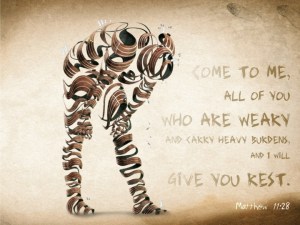
Because society would say that Jesus doesn’t give rest to the weary. Becuase Jesus doesn’t make everything magically easy for every believer. And when society hears rest they think easy. But here is the thing with this, Jesus says I will give you rest not take away your concerns or make everything easy.
Take my yoke upon you…
 What is a yoke?
Not an egg center!
It is a way to distribute the weight of an item.
It is a way to give some of your stress and concerns to Jesus so you aren’t pulling them on your own.
So Jesus doesn’t make your life easy, but He walks with you to help you carry the load.
So take His yoke and know He is helping you through life!
I’ll be singing
 I will sing of your steadfast love, O Lord, forever; with my mouth I will proclaim your faithfulness to all generations. I declare that your steadfast love is established forever; your faithfulness is as firm as the heavens. You said, “I have made a covenant with my chosen one, I have sworn to my servant David: ‘I will establish your descendants forever, and build your throne for all generations.’” Let the heavens praise your wonders, O Lord, your faithfulness in the assembly of the holy ones. For who in the skies can be compared to the Lord? Who among the heavenly beings is like the Lord, a God feared in the council of the holy ones, great and awesome above all that are around him? O Lord God of hosts, who is as mighty as you, O Lord? Your faithfulness surrounds you. You rule the raging of the sea; when its waves rise, you still them. You crushed Rahab like a carcass; you scattered your enemies with your mighty arm. The heavens are yours, the earth also is yours; the world and all that is in it—you have founded them. The north and the south—you created them; Tabor and Hermon joyously praise your name. You have a mighty arm; strong is your hand, high your right hand. Righteousness and justice are the foundation of your throne; steadfast love and faithfulness go before you. Happy are the people who know the festal shout, who walk, O Lord, in the light of your countenance; they exult in your name all day long, and extol your righteousness. For you are the glory of their strength; by your favor our horn is exalted. For our shield belongs to the Lord, our king to the Holy One of Israel. (Psalm 89:1-18, NRSV)
I’ll be singing!
I’ll be singing of the steadfast love of the Lord because He is true to His promises and the covenant He made.
He is worthy of our praise and my singing will make known His marvelous love!
So sing to and about the Lord for He is worthy to be praised and all the world should hear of His love for them!
What drives you?
 Let mutual love continue. Do not neglect to show hospitality to strangers, for by doing that some have entertained angels without knowing it.Remember those who are in prison, as though you were in prison with them; those who are being tortured, as though you yourselves were being tortured. Let marriage be held in honor by all, and let the marriage bed be kept undefiled; for God will judge fornicators and adulterers. Keep your lives free from the love of money, and be content with what you have; for he has said, “I will never leave you or forsake you.” So we can say with confidence, “The Lord is my helper; I will not be afraid. What can anyone do to me?” Remember your leaders, those who spoke the word of God to you; consider the outcome of their way of life, and imitate their faith. Jesus Christ is the same yesterday and today and forever. Do not be carried away by all kinds of strange teachings; for it is well for the heart to be strengthened by grace, not by regulations about food, which have not benefited those who observe them. We have an altar from which those who officiate in the tent have no right to eat. For the bodies of those animals whose blood is brought into the sanctuary by the high priest as a sacrifice for sin are burned outside the camp. Therefore Jesus also suffered outside the city gate in order to sanctify the people by his own blood. Let us then go to him outside the camp and bear the abuse he endured. For here we have no lasting city, but we are looking for the city that is to come. Through him, then, let us continually offer a sacrifice of praise to God, that is, the fruit of lips that confess his name. Do not neglect to do good and to share what you have, for such sacrifices are pleasing to God. (Hebrews 13:1-16, NRSV)
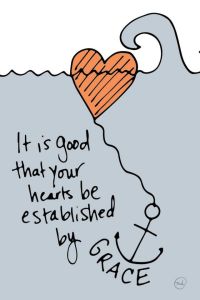
Do not be worried about regulations, but fix your heart in Grace.
Always do good to everyone for you never know when you are entertaining an angel.
Hold everything in honor and live a life worthy of the gospel.
You do this by anchoring your life in the mercy and grace God gave you. And allow that to be the thing that drives you, not rules and regulations.
So be held in grace and nothing else and allow that to move you through life!
who do you serve?
 Therefore, do not let sin exercise dominion in your mortal bodies, to make you obey their passions. No longer present your members to sin as instruments of wickedness, but present yourselves to God as those who have been brought from death to life, and present your members to God as instruments of righteousness. For sin will have no dominion over you, since you are not under law but under grace. What then? Should we sin because we are not under law but under grace? By no means! Do you not know that if you present yourselves to anyone as obedient slaves, you are slaves of the one whom you obey, either of sin, which leads to death, or of obedience, which leads to righteousness? But thanks be to God that you, having once been slaves of sin, have become obedient from the heart to the form of teaching to which you were entrusted, and that you, having been set free from sin, have become slaves of righteousness. I am speaking in human terms because of your natural limitations. For just as you once presented your members as slaves to impurity and to greater and greater iniquity, so now present your members as slaves to righteousness for sanctification. When you were slaves of sin, you were free in regard to righteousness. So what advantage did you then get from the things of which you now are ashamed? The end of those things is death. But now that you have been freed from sin and enslaved to God, the advantage you get is sanctification. The end is eternal life. For the wages of sin is death, but the free gift of God is eternal life in Christ Jesus our Lord. (Romans 6:12-23, NRSV)
Who do you serve?
Do you serve Sin?
Or do you serve God?
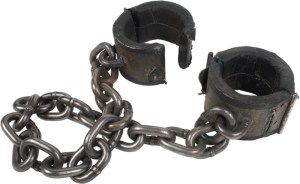
You see we are free to do what we want but also when God has set us free from the bondage of sin we are a dutiful servant of all, as Martin Luther said in On Christian Liberty “A Christian is a perfectly free lord of all, subject to none. A Christian is a perfectly dutiful servant of all, subject of all, subject to all.” We are either a slave to ourselves or sin or a slave of the most high God.
So be free in the life of grace that God has gifted you with, and let go of the sinfulness that was your life, and live as a servant to God.
Faithful to the Lord
 The Lord appeared to Abraham by the oaks of Mamre, as he sat at the entrance of his tent in the heat of the day. He looked up and saw three men standing near him. When he saw them, he ran from the tent entrance to meet them, and bowed down to the ground. He said, “My lord, if I find favor with you, do not pass by your servant. Let a little water be brought, and wash your feet, and rest yourselves under the tree. Let me bring a little bread, that you may refresh yourselves, and after that you may pass on—since you have come to your servant.” So they said, “Do as you have said.” And Abraham hastened into the tent to Sarah, and said, “Make ready quickly three measures of choice flour, knead it, and make cakes.” Abraham ran to the herd, and took a calf, tender and good, and gave it to the servant, who hastened to prepare it.Then he took curds and milk and the calf that he had prepared, and set it before them; and he stood by them under the tree while they ate. They said to him, “Where is your wife Sarah?” And he said, “There, in the tent.” Then one said, “I will surely return to you in due season, and your wife Sarah shall have a son.” And Sarah was listening at the tent entrance behind him. (Genesis 18:1-10, NRSV)
How do we entertain those who visit?
Do we give them our best, curds and cakes and the finest calf? Or do we give them a quick drink and some crackers we have lying around?
Abraham didn’t know these were angels, messengers from God, he could have assumed so, but the text doesn’t say he knew. And they didn’t say who they were. So Abraham didn’t treat them to the best because they were important. He treated them to the best because that is what he does.
And that is what God wants us to do. The blessing of Abraham and Sarah is because they are held accountable for what God has asked them to do. They are faithful to the Lord.
Are we faithful to the Lord?
 aSacredRebel