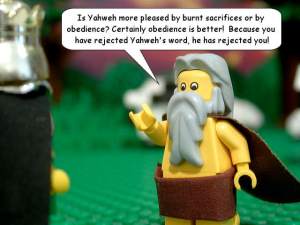
 The word of the Lord came to Samuel: “I regret that I made Saul king, for he has turned back from following me, and has not carried out my commands.” Samuel was angry; and he cried out to the Lord all night.Samuel rose early in the morning to meet Saul, and Samuel was told, “Saul went to Carmel, where he set up a monument for himself, and on returning he passed on down to Gilgal.” When Samuel came to Saul, Saul said to him, “May you be blessed by the Lord; I have carried out the command of the Lord.” But Samuel said, “What then is this bleating of sheep in my ears, and the lowing of cattle that I hear?” Saul said, “They have brought them from the Amalekites; for the people spared the best of the sheep and the cattle, to sacrifice to the Lord your God; but the rest we have utterly destroyed.” Then Samuel said to Saul, “Stop! I will tell you what the Lord said to me last night.” He replied, “Speak.” Samuel said, “Though you are little in your own eyes, are you not the head of the tribes of Israel? The Lord anointed you king over Israel. And the Lord sent you on a mission, and said, ‘Go, utterly destroy the sinners, the Amalekites, and fight against them until they are consumed.’ Why then did you not obey the voice of the Lord? Why did you swoop down on the spoil, and do what was evil in the sight of the Lord?” Saul said to Samuel, “I have obeyed the voice of the Lord, I have gone on the mission on which the Lord sent me, I have brought Agag the king of Amalek, and I have utterly destroyed the Amalekites. But from the spoil the people took sheep and cattle, the best of the things devoted to destruction, to sacrifice to the Lord your God in Gilgal.” And Samuel said, “Has the Lord as great delight in burnt offerings and sacrifices, as in obeying the voice of the Lord? Surely, to obey is better than sacrifice, and to heed than the fat of rams. For rebellion is no less a sin than divination, and stubbornness is like iniquity and idolatry. Because you have rejected the word of the Lord, he has also rejected you from being king.” Saul said to Samuel, “I have sinned; for I have transgressed the commandment of the Lord and your words, because I feared the people and obeyed their voice. Now therefore, I pray, pardon my sin, and return with me, so that I may worship the Lord.” Samuel said to Saul, “I will not return with you; for you have rejected the word of the Lord, and the Lord has rejected you from being king over Israel.” As Samuel turned to go away, Saul caught hold of the hem of his robe, and it tore. And Samuel said to him, “The Lord has torn the kingdom of Israel from you this very day, and has given it to a neighbor of yours, who is better than you.Moreover the Glory of Israel will not recant or change his mind; for he is not a mortal, that he should change his mind.” Then Saul said, “I have sinned; yet honor me now before the elders of my people and before Israel, and return with me, so that I may worship the Lord your God.” So Samuel turned back after Saul; and Saul worshiped the Lord. Then Samuel said, “Bring Agag king of the Amalekites here to me.” And Agag came to him haltingly. Agag said, “Surely this is the bitterness of death.” But Samuel said, “As your sword has made women childless, so your mother shall be childless among women.” And Samuel hewed Agag in pieces before the Lord in Gilgal. Then Samuel went to Ramah; and Saul went up to his house in Gibeah of Saul. (1 Samuel 15:10-34, NRSV)
Does the Lord desire sacrifice or obeying?
We saw a couple weeks ago that there are things you can do that God will not allow sacrifices and penance to forgive. See Eli and chapter 3 of 1 Samuel.
So which is better offering sacrifices or obeying what God has commanded?
And how would not obeying God for the purpose of sacrifice really seem like something that would be good?
When in doubt, do what God commands you to…
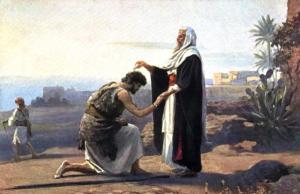 As they were going down to the outskirts of the town, Samuel said to Saul, “Tell the boy to go on before us, and when he has passed on, stop here yourself for a while, that I may make known to you the word of God.” Samuel took a vial of oil and poured it on his head, and kissed him; he said, “The
 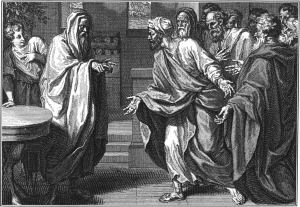 When Samuel became old, he made his sons judges over Israel. The name of his firstborn son was Joel, and the name of his second, Abijah; they were judges in Beer-sheba. Yet his sons did not follow in his ways, but turned aside after gain; they took bribes and perverted justice. Then all the elders of Israel gathered together and came to Samuel at Ramah, and said to him, “You are old and your sons do not follow in your ways; appoint for us, then, a king to govern us, like other nations.” But the thing displeased Samuel when they said, “Give us a king to govern us.” Samuel prayed to the
 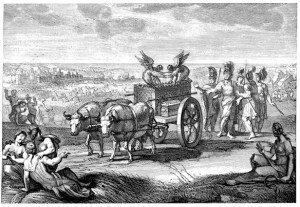 The ark of the
 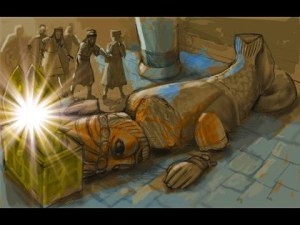 When the Philistines captured the ark of God, they brought it from Ebenezer to Ashdod; then the Philistines took the ark of God and brought it into the house of Dagon and placed it beside Dagon. When the people of Ashdod rose early the next day, there was Dagon, fallen on his face to the ground before the ark of the
 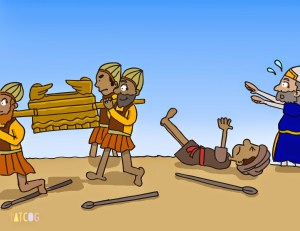 And the word of Samuel came to all Israel. In those days the Philistines mustered for war against Israel, and Israel went out to battle against them; they encamped at Ebenezer, and the Philistines encamped at Aphek. The Philistines drew up in line against Israel, and when the battle was joined, Israel was defeated by the Philistines, who killed about four thousand men on the field of battle. When the troops came to the camp, the elders of Israel said, “Why has the
  Now the boy Samuel was ministering to the
  Hannah prayed and said, “My heart exults in the
  There was a certain man of Ramathaim, a Zuphite from the hill country of Ephraim, whose name was Elkanah son of Jeroham son of Elihu son of Tohu son of Zuph, an Ephraimite. He had two wives; the name of the one was Hannah, and the name of the other Peninnah. Peninnah had children, but Hannah had no children. Now this man used to go up year by year from his town to worship and to sacrifice to the
 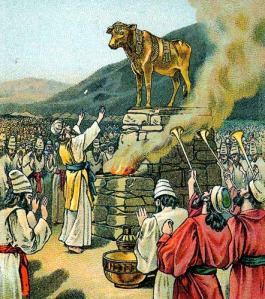 When the people saw that Moses delayed to come down from the mountain, the people gathered around Aaron, and said to him, “Come, make gods for us, who shall go before us; as for this Moses, the man who brought us up out of the land of Egypt, we do not know what has become of him.” Aaron said to them, “Take off the gold rings that are on the ears of your wives, your sons, and your daughters, and bring them to me.” So all the people took off the gold rings from their ears, and brought them to Aaron. He took the gold from them, formed it in a mold, and cast an image of a calf; and they said, “These are your gods, O Israel, who brought you up out of the land of Egypt!” When Aaron saw this, he built an altar before it; and Aaron made proclamation and said, “Tomorrow shall be a festival to the
  aSacredRebel