 Paul and Timothy, servants of Christ Jesus, To all the saints in Christ Jesus who are in Philippi, with the bishops and deacons: Grace to you and peace from God our Father and the Lord Jesus Christ. I thank my God every time I remember you, constantly praying with joy in every one of my prayers for all of you, because of your sharing in the gospel from the first day until now. I am confident of this, that the one who began a good work among you will bring it to completion by the day of Jesus Christ. It is right for me to think this way about all of you, because you hold me in your heart, for all of you share in God’s grace with me, both in my imprisonment and in the defense and confirmation of the gospel. For God is my witness, how I long for all of you with the compassion of Christ Jesus. And this is my prayer, that your love may overflow more and more with knowledge and full insight to help you to determine what is best, so that in the day of Christ you may be pure and blameless, having produced the harvest of righteousness that comes through Jesus Christ for the glory and praise of God. I want you to know, beloved that what has happened to me has actually helped to spread the gospel, so that it has become known throughout the whole imperial guard and to everyone else that my imprisonment is for Christ; and most of the brothers and sisters, having been made confident in the Lord by my imprisonment, dare to speak the word with greater boldness and without fear. Some proclaim Christ from envy and rivalry, but others from goodwill. These proclaim Christ out of love, knowing that I have been put here for the defense of the gospel; the others proclaim Christ out of selfish ambition, not sincerely but intending to increase my suffering in my imprisonment. What does it matter? Just this, that Christ is proclaimed in every way, whether out of false motives or true; and in that I rejoice. (Philippians 1:1-18a, NRSV)
Who is the you in the above opening? And is it you singular or you plural? And does that make a difference?
Well to answer those questions we should really start with the last. Yes, it does make a difference if it is Y’all or all Y’all.
So which is it Y’all or all Y’all?
It is hard to tell in English, however, in Greek, it is super clear. It is all Y’all. The letter is not written to the leader of the church in Philippi but is written to the whole congregation. Because one person is not responsible for transmitting the gospel, we are all. It is a partnership we all take part in.
So know your part in the mission is important, as important as anyone else’s.

 In the morning the Jews joined in a conspiracy and bound themselves by an oath neither to eat nor drink until they had killed Paul. There were more than forty who joined in this conspiracy. They went to the chief priests and elders and said, “We have strictly bound ourselves by an oath to taste no food until we have killed Paul. Now then, you and the council must notify the tribune to bring him down to you, on the pretext that you want to make a more thorough examination of his case. And we are ready to do away with him before he arrives.” Now the son of Paul’s sister heard about the ambush; so he went and gained entrance to the barracks and told Paul. Paul called one of the centurions and said, “Take this young man to the tribune, for he has something to report to him.” So he took him, brought him to the tribune, and said, “The prisoner Paul called me and asked me to bring this young man to you; he has something to tell you.” The tribune took him by the hand, drew him aside privately, and asked, “What is it that you have to report to me?” He answered, “The Jews have agreed to ask you to bring Paul down to the council tomorrow, as though they were going to inquire more thoroughly into his case. But do not be persuaded by them, for more than forty of their men are lying in ambush for him. They have bound themselves by an oath neither to eat nor drink until they kill him. They are ready now and are waiting for your consent.” So the tribune dismissed the young man, ordering him, “Tell no one that you have informed me of this.” (Acts 23:12-22, NRSV)
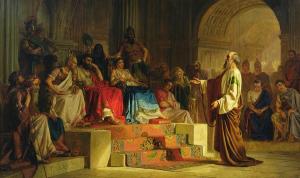 Just as Paul was about to be brought into the barracks, he said to the tribune, “May I say something to you?” The tribune replied, “Do you know Greek? Then you are not the Egyptian who recently stirred up a revolt and led the four thousand assassins out into the wilderness?” Paul replied, “I am a Jew, from Tarsus in Cilicia, a citizen of an important city; I beg you, let me speak to the people.” When he had given him permission, Paul stood on the steps and motioned to the people for silence; and when there was a great hush, he addressed them in the Hebrew language, saying: ”Brothers and fathers, listen to the defense that I now make before you.”When they heard him addressing them in Hebrew, they became even more quiet. Then he said: ”I am a Jew, born in Tarsus in Cilicia, but brought up in this city at the feet of Gamaliel, educated strictly according to our ancestral law, being zealous for God, just as all of you are today. I persecuted this Way up to the point of death by binding both men and women and putting them in prison, as the high priest and the whole council of elders can testify about me. From them I also received letters to the brothers in Damascus, and I went there in order to bind those who were there and to bring them back to Jerusalem for punishment. (Acts 21:37-22:5, NRSV)
 When the seven days were almost completed, the Jews from Asia, who had seen him in the temple, stirred up the whole crowd. They seized him, shouting, “Fellow Israelites, help! This is the man who is teaching everyone everywhere against our people, our law, and this place; more than that, he has actually brought Greeks into the temple and has defiled this holy place.” For they had previously seen Trophimus the Ephesian with him in the city, and they supposed that Paul had brought him into the temple. Then all the city was aroused, and the people rushed together. They seized Paul and dragged him out of the temple, and immediately the doors were shut. While they were trying to kill him, word came to the tribune of the cohort that all Jerusalem was in an uproar. Immediately he took soldiers and centurions and ran down to them. When they saw the tribune and the soldiers, they stopped beating Paul.Then the tribune came, arrested him, and ordered him to be bound with two chains; he inquired who he was and what he had done. Some in the crowd shouted one thing, some another; and as he could not learn the facts because of the uproar, he ordered him to be brought into the barracks. When Paul came to the steps, the violence of the mob was so great that he had to be carried by the soldiers. The crowd that followed kept shouting, “Away with him!” (Acts 21:27-36, NRSV)
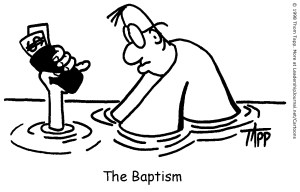 I recently read an article from Luther Seminary about the two dirty words in the church. Evangelism is one. Because we find it hard to understand our faith enough to talk about it with others. Or maybe we think if we don’t know the answer to every question they ask we will look like our faith isn’t really ours. Trust me on this, I get it because I do not know the answer to all of the questions about faith. Have you seen the sign on my office door? It says, “I don’t have any answers. I’m a non-prophet.” But the other dirty word in the church is Stewardship. Because stewardship brings up the f-word. Finances.
 While Paul was waiting for them in Athens, he was deeply distressed to see that the city was full of idols. So he argued in the synagogue with the Jews and the devout persons, and also in the marketplace every day with those who happened to be there. Also some Epicurean and Stoic philosophers debated with him. Some said, “What does this babbler want to say?” Others said, “He seems to be a proclaimer of foreign divinities.” (This was because he was telling the good news about Jesus and the resurrection.) So they took him and brought him to the Areopagus and asked him, “May we know what this new teaching is that you are presenting? It sounds rather strange to us, so we would like to know what it means.” Now all the Athenians and the foreigners living there would spend their time in nothing but telling or hearing something new. Then Paul stood in front of the Areopagus and said, “Athenians, I see how extremely religious you are in every way. For as I went through the city and looked carefully at the objects of your worship, I found among them an altar with the inscription, ‘To an unknown god.’ What therefore you worship as unknown, this I proclaim to you. The God who made the world and everything in it, he who is Lord of heaven and earth, does not live in shrines made by human hands, nor is he served by human hands, as though he needed anything, since he himself gives to all mortals life and breath and all things. From one ancestor he made all nations to inhabit the whole earth, and he allotted the times of their existence and the boundaries of the places where they would live, so that they would search for God and perhaps grope for him and find him—though indeed he is not far from each one of us. For ‘In him we live and move and have our being’; as even some of your own poets have said, ‘For we too are his offspring.’ Since we are God’s offspring, we ought not to think that the deity is like gold, or silver, or stone, an image formed by the art and imagination of mortals. While God has overlooked the times of human ignorance, now he commands all people everywhere to repent, because he has fixed a day on which he will have the world judged in righteousness by a man whom he has appointed, and of this he has given assurance to all by raising him from the dead.” (Acts 17:16-31, NRSV)

