 When someone steals an ox or a sheep, and slaughters it or sells it, the thief shall pay five oxen for an ox, and four sheep for a sheep. The thief shall make restitution, but if unable to do so, shall be sold for the theft. When the animal, whether ox or donkey or sheep, is found alive in the thief’s possession, the thief shall pay double. If a thief is found breaking in, and is beaten to death, no bloodguilt is incurred; but if it happens after sunrise, bloodguilt is incurred. When someone causes a field or vineyard to be grazed over, or lets livestock loose to graze in someone else’s field, restitution shall be made from the best in the owner’s field or vineyard. When fire breaks out and catches in thorns so that the stacked grain or the standing grain or the field is consumed, the one who started the fire shall make full restitution. When someone delivers to a neighbor money or goods for safekeeping, and they are stolen from the neighbor’s house, then the thief, if caught, shall pay double. If the thief is not caught, the owner of the house shall be brought before God, to determine whether or not the owner had laid hands on the neighbor’s goods. In any case of disputed ownership involving ox, donkey, sheep, clothing, or any other loss, of which one party says, “This is mine,” the case of both parties shall come before God; the one whom God condemns shall pay double to the other. When someone delivers to another a donkey, ox, sheep, or any other animal for safekeeping, and it dies or is injured or is carried off, without anyone seeing it, an oath before the Lord shall decide between the two of them that the one has not laid hands on the property of the other; the owner shall accept the oath, and no restitution shall be made. But if it was stolen, restitution shall be made to its owner. If it was mangled by beasts, let it be brought as evidence; restitution shall not be made for the mangled remains. When someone borrows an animal from another and it is injured or dies, the owner not being present, full restitution shall be made. If the owner was present, there shall be no restitution; if it was hired, only the hiring fee is due. (Exodus 22:1-15, NRSV)
Basically, from all of this, we get if you do wrong to your neighbor you need to pay them double. So, in short, don’t wrong your neighbor.
Love your neighbor and don’t take their stuff. Do for them as you would like others to do to you and protect their stuff as well as you protect yours.
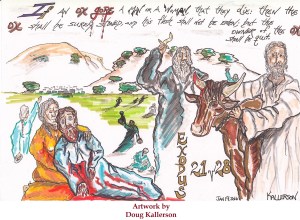 When an ox gores a man or a woman to death, the ox shall be stoned, and its flesh shall not be eaten; but the owner of the ox shall not be liable. If the ox has been accustomed to gore in the past, and its owner has been warned but has not restrained it, and it kills a man or a woman, the ox shall be stoned, and its owner also shall be put to death. If a ransom is imposed on the owner, then the owner shall pay whatever is imposed for the redemption of the victim’s life. If it gores a boy or a girl, the owner shall be dealt with according to this same rule. If the ox gores a male or female slave, the owner shall pay to the slaveowner thirty shekels of silver, and the ox shall be stoned. If someone leaves a pit open, or digs a pit and does not cover it, and an ox or a donkey falls into it, the owner of the pit shall make restitution, giving money to its owner, but keeping the dead animal. If someone’s ox hurts the ox of another, so that it dies, then they shall sell the live ox and divide the price of it; and the dead animal they shall also divide. But if it was known that the ox was accustomed to gore in the past, and its owner has not restrained it, the owner shall restore ox for ox, but keep the dead animal. (Exodus 21:28-36, NRSV)
 Whoever strikes a person mortally shall be put to death. If it was not premeditated, but came about by an act of God, then I will appoint for you a place to which the killer may flee. But if someone willfully attacks and kills another by treachery, you shall take the killer from my altar for execution. Whoever strikes father or mother shall be put to death. Whoever kidnaps a person, whether that person has been sold or is still held in possession, shall be put to death. Whoever curses father or mother shall be put to death. When individuals quarrel and one strikes the other with a stone or fist so that the injured party, though not dead, is confined to bed, but recovers and walks around outside with the help of a staff, then the assailant shall be free of liability, except to pay for the loss of time, and to arrange for full recovery. When a slaveowner strikes a male or female slave with a rod and the slave dies immediately, the owner shall be punished. But if the slave survives a day or two, there is no punishment; for the slave is the owner’s property. When people who are fighting injure a pregnant woman so that there is a miscarriage, and yet no further harm follows, the one responsible shall be fined what the woman’s husband demands, paying as much as the judges determine. If any harm follows, then you shall give life for life, eye for eye, tooth for tooth, hand for hand, foot for foot, burn for burn, wound for wound, stripe for stripe. When a slaveowner strikes the eye of a male or female slave, destroying it, the owner shall let the slave go, a free person, to compensate for the eye. If the owner knocks out a tooth of a male or female slave, the slave shall be let go, a free person, to compensate for the tooth. (Exodus 21:12-27, NRSV)
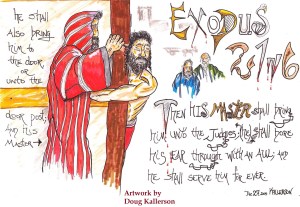 These are the ordinances that you shall set before them: When you buy a male Hebrew slave, he shall serve six years, but in the seventh he shall go out a free person, without debt. If he comes in single, he shall go out single; if he comes in married, then his wife shall go out with him. If his master gives him a wife and she bears him sons or daughters, the wife and her children shall be her master’s and he shall go out alone. But if the slave declares, “I love my master, my wife, and my children; I will not go out a free person,” then his master shall bring him before God. He shall be brought to the door or the doorpost; and his master shall pierce his ear with an awl; and he shall serve him for life. When a man sells his daughter as a slave, she shall not go out as the male slaves do. If she does not please her master, who designated her for himself, then he shall let her be redeemed; he shall have no right to sell her to a foreign people, since he has dealt unfairly with her. If he designates her for his son, he shall deal with her as with a daughter. If he takes another wife to himself, he shall not diminish the food, clothing, or marital rights of the first wife. And if he does not do these three things for her, she shall go out without debt, without payment of money. (Exodus 21:1-11, NRSV)
 Honor your father and your mother, so that your days may be long in the land that the
  For six years you shall sow your land and gather in its yield; but the seventh year you shall let it rest and lie fallow, so that the poor of your people may eat; and what they leave the wild animals may eat. You shall do the same with your vineyard, and with your olive orchard. Six days you shall do your work, but on the seventh day you shall rest, so that your ox and your donkey may have relief, and your homeborn slave and the resident alien may be refreshed. Be attentive to all that I have said to you. Do not invoke the names of other gods; do not let them be heard on your lips. (Exodus 23:10-13, NRSV)
 The
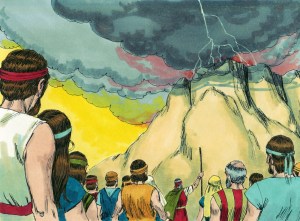
The  When all the people witnessed the thunder and lightning, the sound of the trumpet, and the mountain smoking, they were afraid and trembled and stood at a distance, and said to Moses, “You speak to us, and we will listen; but do not let God speak to us, or we will die.” Moses said to the people, “Do not be afraid; for God has come only to test you and to put the fear of him upon you so that you do not sin.” Then the people stood at a distance, while Moses drew near to the thick darkness where God was. (Exodus 20:18-21, NRSV)
 So Moses came, summoned the elders of the people, and set before them all these words that the
 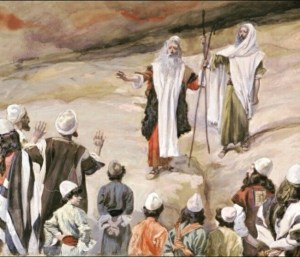 The next day Moses sat as judge for the people, while the people stood around him from morning until evening. When Moses’ father-in-law saw all that he was doing for the people, he said, “What is this that you are doing for the people? Why do you sit alone, while all the people stand around you from morning until evening?” Moses said to his father-in-law, “Because the people come to me to inquire of God. When they have a dispute, they come to me and I decide between one person and another, and I make known to them the statutes and instructions of God.” Moses’ father-in-law said to him, “What you are doing is not good. You will surely wear yourself out, both you and these people with you. For the task is too heavy for you; you cannot do it alone. Now listen to me. I will give you counsel, and God be with you! You should represent the people before God, and you should bring their cases before God; teach them the statutes and instructions and make known to them the way they are to go and the things they are to do. You should also look for able men among all the people, men who fear God, are trustworthy, and hate dishonest gain; set such men over them as officers over thousands, hundreds, fifties and tens. Let them sit as judges for the people at all times; let them bring every important case to you, but decide every minor case themselves. So it will be easier for you, and they will bear the burden with you. If you do this, and God so commands you, then you will be able to endure, and all these people will go to their home in peace.” So Moses listened to his father-in-law and did all that he had said. Moses chose able men from all Israel and appointed them as heads over the people, as officers over thousands, hundreds, fifties, and tens. And they judged the people at all times; hard cases they brought to Moses, but any minor case they decided themselves. Then Moses let his father-in-law depart, and he went off to his own country. (Exodus 18:13-27, NRSV)
