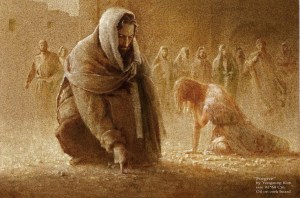
 Then each of them went home, while Jesus went to the Mount of Olives. Early in the morning he came again to the temple. All the people came to him and he sat down and began to teach them. The scribes and the Pharisees brought a woman who had been caught in adultery; and making her stand before all of them, they said to him, “Teacher, this woman was caught in the very act of committing adultery. Now in the law Moses commanded us to stone such women. Now what do you say?” They said this to test him, so that they might have some charge to bring against him. Jesus bent down and wrote with his finger on the ground. When they kept on questioning him, he straightened up and said to them, “Let anyone among you who is without sin be the first to throw a stone at her.” And once again he bent down and wrote on the ground. When they heard it, they went away, one by one, beginning with the elders; and Jesus was left alone with the woman standing before him. Jesus straightened up and said to her, “Woman, where are they? Has no one condemned you?” She said, “No one, sir.” And Jesus said, “Neither do I condemn you. Go your way, and from now on do not sin again.” (John 7:53-8:11, NRSV)
I have always wondered what was Jesus writing in the sand. But this isn’t the point of the story.
One detail we seem to overlook is there was one who was present who could have cast a stone. Someone who is without Sin. The one who was writing in the sand. Jesus could have cast the first stone but He did not hold her sin against her. He did not condemn her like he doesn’t condemn us.
What are you holding against others you need to let go?

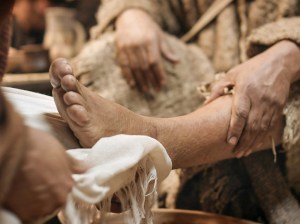 Now before the festival of the Passover, Jesus knew that his hour had come to depart from this world and go to the Father. Having loved his own who were in the world, he loved them to the end. The devil had already put it into the heart of Judas son of Simon Iscariot to betray him. And during supper Jesus, knowing that the Father had given all things into his hands, and that he had come from God and was going to God,got up from the table, took off his outer robe, and tied a towel around himself. Then he poured water into a basin and began to wash the disciples’ feet and to wipe them with the towel that was tied around him.He came to Simon Peter, who said to him, “Lord, are you going to wash my feet?” Jesus answered, “You do not know now what I am doing, but later you will understand.” Peter said to him, “You will never wash my feet.” Jesus answered, “Unless I wash you, you have no share with me.”Simon Peter said to him, “Lord, not my feet only but also my hands and my head!” Jesus said to him, “One who has bathed does not need to wash, except for the feet, but is entirely clean. And you are clean, though not all of you.” For he knew who was to betray him; for this reason he said, “Not all of you are clean.” After he had washed their feet, had put on his robe, and had returned to the table, he said to them, “Do you know what I have done to you? You call me Teacher and Lord—and you are right, for that is what I am. So if I, your Lord and Teacher, have washed your feet, you also ought to wash one another’s feet. For I have set you an example, that you also should do as I have done to you. Very truly, I tell you, servants are not greater than their master, nor are messengers greater than the one who sent them. If you know these things, you are blessed if you do them. (John 13:1-17, NRSV)
 Then the temple police went back to the chief priests and Pharisees, who asked them, “Why did you not arrest him?” The police answered, “Never has anyone spoken like this!” Then the Pharisees replied, “Surely you have not been deceived too, have you? Has anyone of the authorities or of the Pharisees believed in him? But this crowd, which does not know the law—they are accursed.” Nicodemus, who had gone to Jesus before, and who was one of them, asked, “Our law does not judge people without first giving them a hearing to find out what they are doing, does it?” They replied, “Surely you are not also from Galilee, are you? Search and you will see that no prophet is to arise from Galilee.” (John 7:45-52, NRSV)
 When they heard these words, some in the crowd said, “This is really the prophet.” Others said, “This is the Messiah.” But some asked, “Surely the Messiah does not come from Galilee, does he? Has not the scripture said that the Messiah is descended from David and comes from Bethlehem, the village where David lived?” So there was a division in the crowd because of him. Some of them wanted to arrest him, but no one laid hands on him. (John 7:40-44, NRSV)
 On the last day of the festival, the great day, while Jesus was standing there, he cried out, “Let anyone who is thirsty come to me, and let the one who believes in me drink. As the scripture has said, ‘Out of the believer’s heart shall flow rivers of living water.’” Now he said this about the Spirit, which believers in him were to receive; for as yet there was no Spirit, because Jesus was not yet glorified. (John 7:37-39, NRSV)
 aSacredRebel