 Whoever strikes a person mortally shall be put to death. If it was not premeditated, but came about by an act of God, then I will appoint for you a place to which the killer may flee. But if someone willfully attacks and kills another by treachery, you shall take the killer from my altar for execution. Whoever strikes father or mother shall be put to death. Whoever kidnaps a person, whether that person has been sold or is still held in possession, shall be put to death. Whoever curses father or mother shall be put to death. When individuals quarrel and one strikes the other with a stone or fist so that the injured party, though not dead, is confined to bed, but recovers and walks around outside with the help of a staff, then the assailant shall be free of liability, except to pay for the loss of time, and to arrange for full recovery. When a slaveowner strikes a male or female slave with a rod and the slave dies immediately, the owner shall be punished. But if the slave survives a day or two, there is no punishment; for the slave is the owner’s property. When people who are fighting injure a pregnant woman so that there is a miscarriage, and yet no further harm follows, the one responsible shall be fined what the woman’s husband demands, paying as much as the judges determine. If any harm follows, then you shall give life for life, eye for eye, tooth for tooth, hand for hand, foot for foot, burn for burn, wound for wound, stripe for stripe. When a slaveowner strikes the eye of a male or female slave, destroying it, the owner shall let the slave go, a free person, to compensate for the eye. If the owner knocks out a tooth of a male or female slave, the slave shall be let go, a free person, to compensate for the tooth. (Exodus 21:12-27, NRSV)
This is a passage that gets quoted a lot, with an eye for an eye and a tooth for a tooth. But do we use that passage correctly?
Do we understand what it means?
It means and this whole passage attests to, you can seek no more from a person than what they took from you. If a person cut off your hand, you can not kill them, or take their arm. The most you can do according to this passage is take their hand. The same hand. If they took you non-dominant hand, you can’t take their dominant hand, you have to take their non-dominant hand.
It is for justice. And not divine retribution. You can not take more than was taken from you.
It is not about getting even in the way we think of that today, but a way to make sure that people pay for what they have done by doing to them what they did to someone else.
Justice.
Are you just in your dealings in the world?
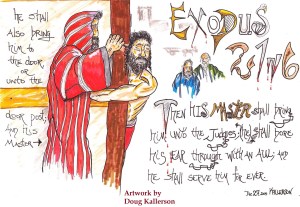 These are the ordinances that you shall set before them: When you buy a male Hebrew slave, he shall serve six years, but in the seventh he shall go out a free person, without debt. If he comes in single, he shall go out single; if he comes in married, then his wife shall go out with him. If his master gives him a wife and she bears him sons or daughters, the wife and her children shall be her master’s and he shall go out alone. But if the slave declares, “I love my master, my wife, and my children; I will not go out a free person,” then his master shall bring him before God. He shall be brought to the door or the doorpost; and his master shall pierce his ear with an awl; and he shall serve him for life. When a man sells his daughter as a slave, she shall not go out as the male slaves do. If she does not please her master, who designated her for himself, then he shall let her be redeemed; he shall have no right to sell her to a foreign people, since he has dealt unfairly with her. If he designates her for his son, he shall deal with her as with a daughter. If he takes another wife to himself, he shall not diminish the food, clothing, or marital rights of the first wife. And if he does not do these three things for her, she shall go out without debt, without payment of money. (Exodus 21:1-11, NRSV)
 Honor your father and your mother, so that your days may be long in the land that the
  For six years you shall sow your land and gather in its yield; but the seventh year you shall let it rest and lie fallow, so that the poor of your people may eat; and what they leave the wild animals may eat. You shall do the same with your vineyard, and with your olive orchard. Six days you shall do your work, but on the seventh day you shall rest, so that your ox and your donkey may have relief, and your homeborn slave and the resident alien may be refreshed. Be attentive to all that I have said to you. Do not invoke the names of other gods; do not let them be heard on your lips. (Exodus 23:10-13, NRSV)
 The
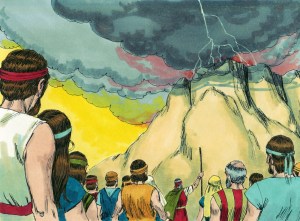
The  When all the people witnessed the thunder and lightning, the sound of the trumpet, and the mountain smoking, they were afraid and trembled and stood at a distance, and said to Moses, “You speak to us, and we will listen; but do not let God speak to us, or we will die.” Moses said to the people, “Do not be afraid; for God has come only to test you and to put the fear of him upon you so that you do not sin.” Then the people stood at a distance, while Moses drew near to the thick darkness where God was. (Exodus 20:18-21, NRSV)
 So Moses came, summoned the elders of the people, and set before them all these words that the
 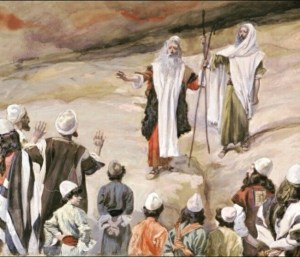 The next day Moses sat as judge for the people, while the people stood around him from morning until evening. When Moses’ father-in-law saw all that he was doing for the people, he said, “What is this that you are doing for the people? Why do you sit alone, while all the people stand around you from morning until evening?” Moses said to his father-in-law, “Because the people come to me to inquire of God. When they have a dispute, they come to me and I decide between one person and another, and I make known to them the statutes and instructions of God.” Moses’ father-in-law said to him, “What you are doing is not good. You will surely wear yourself out, both you and these people with you. For the task is too heavy for you; you cannot do it alone. Now listen to me. I will give you counsel, and God be with you! You should represent the people before God, and you should bring their cases before God; teach them the statutes and instructions and make known to them the way they are to go and the things they are to do. You should also look for able men among all the people, men who fear God, are trustworthy, and hate dishonest gain; set such men over them as officers over thousands, hundreds, fifties and tens. Let them sit as judges for the people at all times; let them bring every important case to you, but decide every minor case themselves. So it will be easier for you, and they will bear the burden with you. If you do this, and God so commands you, then you will be able to endure, and all these people will go to their home in peace.” So Moses listened to his father-in-law and did all that he had said. Moses chose able men from all Israel and appointed them as heads over the people, as officers over thousands, hundreds, fifties, and tens. And they judged the people at all times; hard cases they brought to Moses, but any minor case they decided themselves. Then Moses let his father-in-law depart, and he went off to his own country. (Exodus 18:13-27, NRSV)
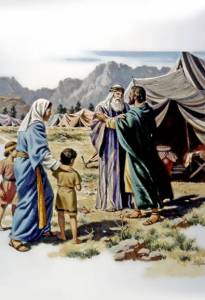 Jethro, the priest of Midian, Moses’ father-in-law, heard of all that God had done for Moses and for his people Israel, how the
 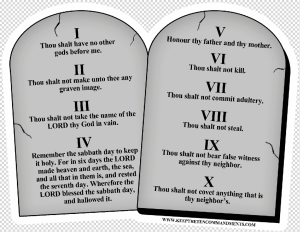 you shall have no other gods before me. You shall not make for yourself an idol, whether in the form of anything that is in heaven above, or that is on the earth beneath, or that is in the water under the earth. You shall not bow down to them or worship them; for I the
  aSacredRebel