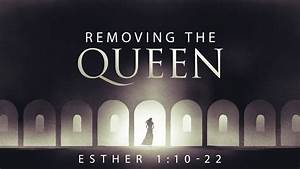
 On the seventh day, when the king was merry with wine, he commanded Mehuman, Biztha, Harbona, Bigtha and Abagtha, Zethar and Carkas, the seven eunuchs who attended him, to bring Queen Vashti before the king, wearing the royal crown, in order to show the peoples and the officials her beauty; for she was fair to behold. But Queen Vashti refused to come at the king’s command conveyed by the eunuchs. At this the king was enraged, and his anger burned within him. Then the king consulted the sages who knew the laws (for this was the king’s procedure toward all who were versed in law and custom, and those next to him were Carshena, Shethar, Admatha, Tarshish, Meres, Marsena, and Memucan, the seven officials of Persia and Media, who had access to the king, and sat first in the kingdom): “According to the law, what is to be done to Queen Vashti because she has not performed the command of King Ahasuerus conveyed by the eunuchs?” Then Memucan said in the presence of the king and the officials, “Not only has Queen Vashti done wrong to the king, but also to all the officials and all the peoples who are in all the provinces of King Ahasuerus. For this deed of the queen will be made known to all women, causing them to look with contempt on their husbands, since they will say, ‘King Ahasuerus commanded Queen Vashti to be brought before him, and she did not come.’ This very day the noble ladies of Persia and Media who have heard of the queen’s behavior will rebel against the king’s officials, and there will be no end of contempt and wrath! If it pleases the king, let a royal order go out from him, and let it be written among the laws of the Persians and the Medes so that it may not be altered, that Vashti is never again to come before King Ahasuerus; and let the king give her royal position to another who is better than she. So when the decree made by the king is proclaimed throughout all his kingdom, vast as it is, all women will give honor to their husbands, high and low alike.” This advice pleased the king and the officials, and the king did as Memucan proposed; he sent letters to all the royal provinces, to every province in its own script and to every people in its own language, declaring that every man should be master in his own house. (Esther 1:10-22, NRSV)
I read this and remember the Veggie Tales version of Esther. Where Queen Vashti won’t make a sandwich for the king. And so she is removed. But here all the king wants is for Vashti to come before the king and all those gathered wearing the royal crown. But she said no. Was it just to come before the people or was there more involved? It was at the end of the feast and they had probably consumed a fair amount of wine. Was she expecting more than just coming before the king?
Should she have been put away for this? The law said yes, not God’s law but the law of the land. And while it might not be fair, God is still with Vashti and all the people. God doesn’t judge as man does, He looks upon the heart. Maybe Vashti knew not to go, and she stood her ground. When should we stand our ground?
 This happened in the days of Ahasuerus, the same Ahasuerus who ruled over one hundred twenty-seven provinces from India to Ethiopia. In those days when King Ahasuerus sat on his royal throne in the citadel of Susa, in the third year of his reign, he gave a banquet for all his officials and ministers. The army of Persia and Media and the nobles and governors of the provinces were present, while he displayed the great wealth of his kingdom and the splendor and pomp of his majesty for many days, one hundred eighty days in all. When these days were completed, the king gave for all the people present in the citadel of Susa, both great and small, a banquet lasting for seven days, in the court of the garden of the king’s palace. There were white cotton curtains and blue hangings tied with cords of fine linen and purple to silver rings and marble pillars. There were couches of gold and silver on a mosaic pavement of porphyry, marble, mother-of-pearl, and colored stones. Drinks were served in golden goblets, goblets of different kinds, and the royal wine was lavished according to the bounty of the king. Drinking was by flagons, without restraint; for the king had given orders to all the officials of his palace to do as each one desired. Furthermore, Queen Vashti gave a banquet for the women in the palace of King Ahasuerus. (Esther 1:1-9, NRSV)
 By the rivers of Babylon— there we sat down and there we wept when we remembered Zion.
 The oracle that the prophet Habakkuk saw. O
 In the ninth year of King Zedekiah of Judah, in the tenth month, King Nebuchadrezzar of Babylon and all his army came against Jerusalem and besieged it; in the eleventh year of Zedekiah, in the fourth month, on the ninth day of the month, a breach was made in the city. When Jerusalem was taken, all the officials of the king of Babylon came and sat in the middle gate: Nergal-sharezer, Samgar-nebo, Sarsechim the Rab-saris, Nergal-sharezer the Rab-mag, with all the rest of the officials of the king of Babylon. When King Zedekiah of Judah and all the soldiers saw them, they fled, going out of the city at night by way of the king’s garden through the gate between the two walls; and they went toward the Arabah. But the army of the Chaldeans pursued them, and overtook Zedekiah in the plains of Jericho; and when they had taken him, they brought him up to King Nebuchadrezzar of Babylon, at Riblah, in the land of Hamath; and he passed sentence on him. The king of Babylon slaughtered the sons of Zedekiah at Riblah before his eyes; also the king of Babylon slaughtered all the nobles of Judah. He put out the eyes of Zedekiah, and bound him in fetters to take him to Babylon. The Chaldeans burned the king’s house and the houses of the people, and broke down the walls of Jerusalem. Then Nebuzaradan the captain of the guard exiled to Babylon the rest of the people who were left in the city, those who had deserted to him, and the people who remained.Nebuzaradan the captain of the guard left in the land of Judah some of the poor people who owned nothing, and gave them vineyards and fields at the same time. King Nebuchadrezzar of Babylon gave command concerning Jeremiah through Nebuzaradan, the captain of the guard, saying, “Take him, look after him well and do him no harm, but deal with him as he may ask you.” So Nebuzaradan the captain of the guard, Nebushazban the Rab-saris, Nergal-sharezer the Rab-mag, and all the chief officers of the king of Babylon sent and took Jeremiah from the court of the guard. They entrusted him to Gedaliah son of Ahikam son of Shaphan to be brought home. So he stayed with his own people. The word of the
  Zedekiah son of Josiah, whom King Nebuchadrezzar of Babylon made king in the land of Judah, succeeded Coniah son of Jehoiakim. But neither he nor his servants nor the people of the land listened to the words of the
  Thus says the
  At that time, says the
  In that same year, at the beginning of the reign of King Zedekiah of Judah, in the fifth month of the fourth year, the prophet Hananiah son of Azzur, from Gibeon, spoke to me in the house of the
  aSacredRebel